

Practice Test for HPE7-A01 Certification Real 2024 Mock Exam
Prepare For Realistic HPE7-A01 Dumps PDF - 100% Passing Guarantee
NEW QUESTION # 41
List the WPA 4-Way Handshake functions in the correct order.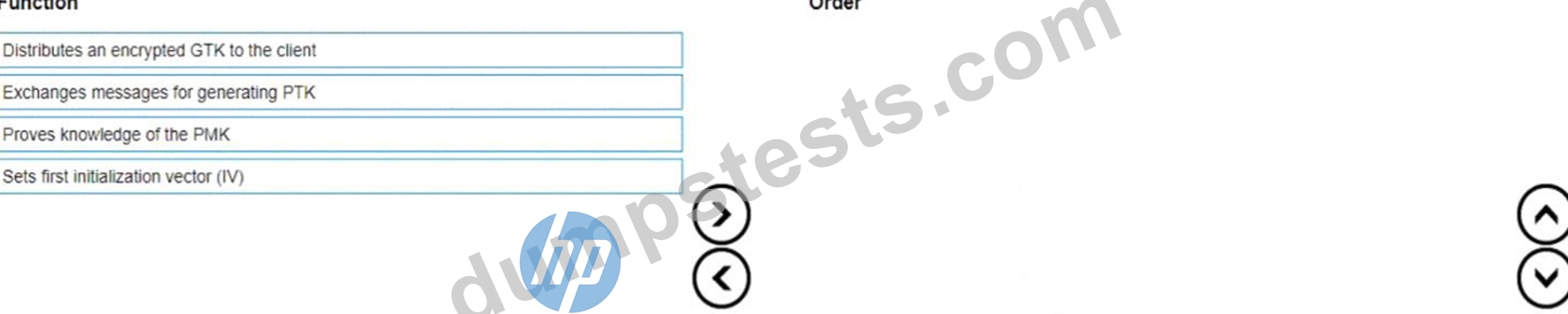
Answer:
Explanation: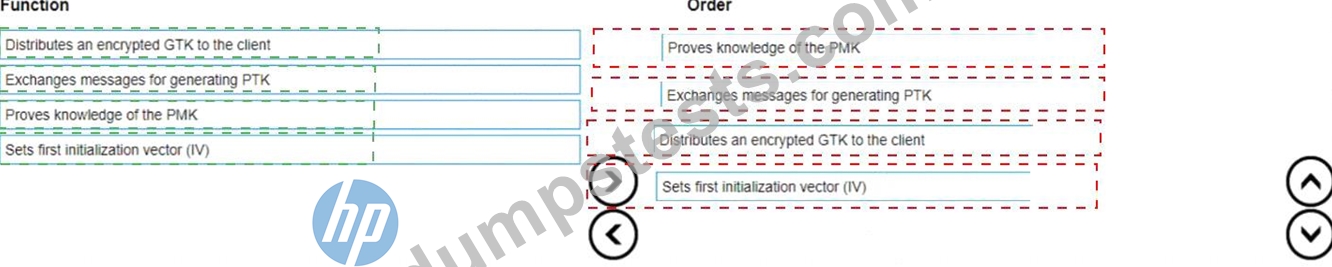
* Proves knowledge of the PMK
* Exchanges messages for generating PTK
* Distributes an encrypted GTK to the client
* Sets first initialization vector (IV)
NEW QUESTION # 42
What is an Aruba-recommended best practice for hardening that only applies to Aruba CX 6300 series switches with dedicated management ports?
- A. Implement a control plane ACL to limit access to approved IPs and/or subnets
- B. Disable all management services on the default VRF.
- C. Create a dedicated management VRF, and assign the management port to it.
- D. Manually enable Enhanced Security Mode from a console session.
Answer: C
Explanation:
This is an Aruba-recommended best practice for hardening that only applies to Aruba CX 6300 series switches with dedicated management ports. A dedicated management port is a physical port that is used exclusively for out-of-band management access to the switch. A dedicated management VRF is a virtual routing and forwarding instance that isolates the management traffic from other traffic on the switch. By creating a dedicated management VRF and assigning the management port to it, the administrator can enhance the security and performance of the management access to the switch. The other options are incorrect because they either do not apply to switches with dedicated management ports or do not follow Aruba-recommended best practices. Reference: https://www.arubanetworks.com/assets/ds/DS_AOS-CX.pdf https://www.arubanetworks.com/assets/tg/TB_ArubaCX_Switching.pdf
NEW QUESTION # 43
Refer to the image.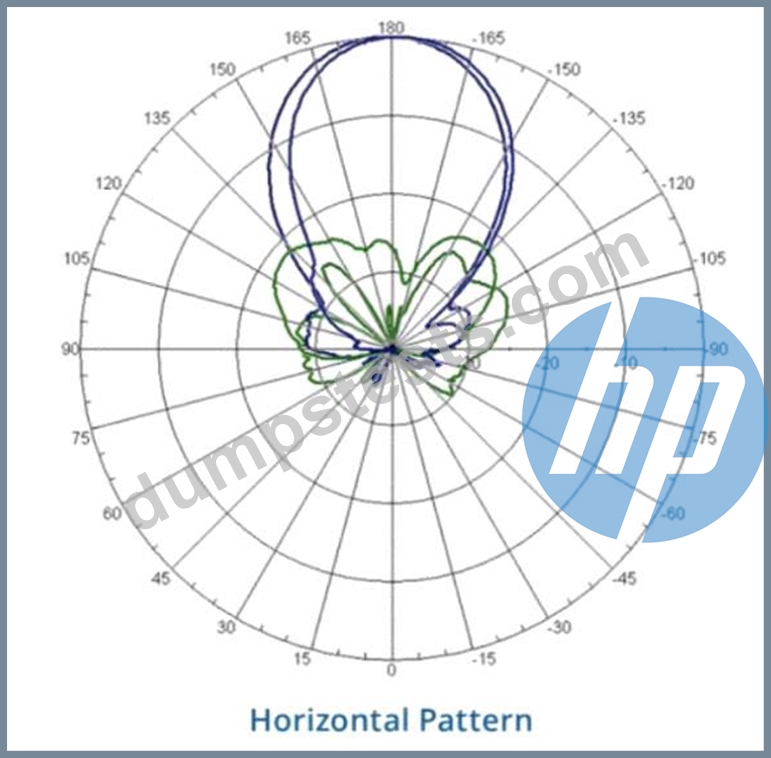
Your customer is complaining of weak Wi-Fi coverage in their office. They mention that the office on the other side of the hall has much better signal What is the likely cause of this issue7
- A. The AP is a remote access point.
- B. The AP is an outdoor access point.
- C. The AP is configured in Mesh mode
- D. The AP is using a directional antenna.
Answer: D
Explanation:
Explanation
The likely cause of the issue of weak Wi-Fi coverage in the office is that the AP is using a directional antenna.
A directional antenna is an antenna that radiates or receives radio waves more strongly in one or more directions, creating a focused beam of signal. A directional antenna can provide better coverage and performance for a specific area, but it can also create dead zones or weak spots for other areas. The other options are incorrect because they either do not affect the Wi-Fi coverage or do not match the scenario.
References:
https://www.arubanetworks.com/techdocs/ArubaOS_86_Web_Help/Content/arubaos-solutions/wlan-rf/rf-fundam
https://www.arubanetworks.com/techdocs/ArubaOS_86_Web_Help/Content/arubaos-solutions/wlan-rf/antennas.
NEW QUESTION # 44
Refer to the exhibit.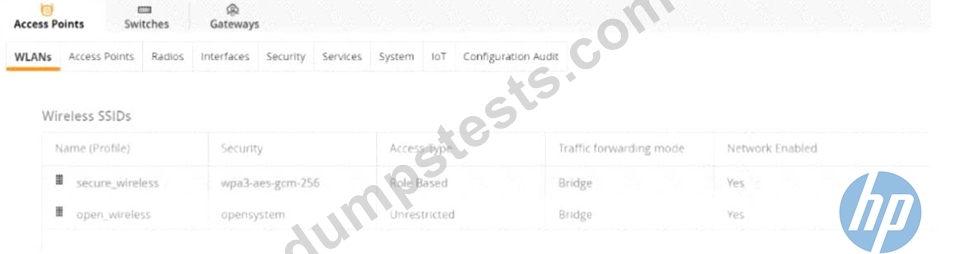
A company has deployed 200 AP-635 access points. To but is not working as expected What would be the correct action to fix the issue?
- A. Change the SSID to WPA3-Personal
- B. Change the SSID to WPA3-Enterprise (CCM).
- C. Change the SSID to WPA3-Enhanced Open
- D. Change the SSID to WPA3-Enterpnse (CNSA).
Answer: C
Explanation:
Explanation
This is the correct action to fix the issue where the SSID is not working as expected. WPA3-Enhanced Open is a new security standard for public networks that uses Opportunistic Wireless Encryption (OWE) to provide encryption and privacy on open, non-password-protected networks. WPA3-Enhanced Open can be configured on an Aruba Access Point by changing the SSID security mode to WPA3-Enhanced Open in Aruba Central or Aruba Instant. The other options are incorrect because they either do not use WPA3-Enhanced Open or do not exist as valid security modes. References:
https://www.arubanetworks.com/assets/wp/WP_WPA3-Enhanced-Open.pdf
https://www.arubanetworks.com/techdocs/Instant_86_WebHelp/Content/instant-ug/wpa3-enhanced-open.htm
NEW QUESTION # 45
With the Aruba CX 6000 24G switch with uplinks of 1/1/25 and what does the switch do when a client port detects a loop and the do-not-disabie parameter is used?
- A. The network analytics engine is triggered.
- B. Port status will be validated once status is cleared
- C. An event log message is created.
- D. Port status led blinks in amber with 100hz.
Answer: C
Explanation:
Explanation
The correct answer is B. An event log message is created.
The do-not-disable parameter is used to prevent the switch from disabling the port when a loop is detected by the loop-protect feature. Instead, the switch will generate an event log message that indicates the port number and the VLAN ID where the loop was detected. The switch will also send a trap to the SNMP manager, if configured1.
The other options are incorrect because:
A: Port status will not be validated once status is cleared. The port will remain enabled even if a loop is detected, unless the loop-protect action is changed to tx-disable or tx-rx-disable1.
C: The network analytics engine will not be triggered by a loop detection. The network analytics engine is a feature that allows users to monitor and troubleshoot network issues using scripts and agents2.
D: Port status LED will not blink in amber with 100Hz. The port status LED will indicate the normal port status, such as link speed and activity, regardless of the loop detection3.
NEW QUESTION # 46
You are building a configuration in Central that will be used for a standardized network design for small sites for your company, you want to use GUI configuration for gateways and Aps, while template configuration for switches. You need to align with Aruba best practices.
Which set of actions will satisfy these requirements?
- A. Create a single group in Central. Create a unique site for each type of device, and assign devices to the appropriate site.
- B. Create a single group in Central. Create a unique site for each location, and assign devices to the appropriate site.
- C. Create one group in Central for switches and a second group for APs and gateways. Create a unique site for each location, and assign devices to the appropriate site.
- D. Create one group in Central for switches a second group for APs. and a third group for gateways Create a unique site for each location, and assign devices to the appropriate site.
Answer: B
Explanation:
Explanation
This is because option C shows how to create a single group in Central with different configuration methods defined for each device type. For example, you can create a group with the name Group1, and within this group, you can enable template-based configuration method for switches and UI-based configuration method for Instant APs and Gateways. Aruba Central identifies both these groups under a single name (Group1). If a device type in the group is marked for template-based configuration method, the group name is prefixed with TG (TG Group1). You can use Group1 as the group ID for workflows such as user management, monitoring, reports, and audit trail2.
https://www.arubanetworks.com/techdocs/central/latest/content/nms/groups/abt-groups.htm 2:
https://www.arubanetworks.com/techdocs/central/latest/content/nms/groups/groups.htm
NEW QUESTION # 47
you need to have different routing-table requirements With Aruba CX 6300 VSF configuration.
Assuming the correct layer-2 VLAN already exists, how would you create a new SVI for a separate routing table?
- A. Create a new routing table, and attach VLANS to it
- B. create a new VLAN, and attach the VRF to it.
- C. Create a new VLAN. and attach the routing table to it
- D. Create a new SVI and use attach command.
Answer: D
Explanation:
The correct answer is C. Create a new SVI and use attach command.
To create a new SVI for a separate routing table, you need to use the attach command to associate the SVI with a VRF (Virtual Routing and Forwarding) instance. A VRF is a logical entity that allows multiple routing tables to coexist on the same switch. Each VRF has its own set of interfaces, routing protocols, and routes that are isolated from other VRFs.
According to the AOS-CX Virtual Switching Framework (VSF) Guide1, one of the steps to configure VRF-aware VSF is:
Configure the VRFs on each member switch and assign the SVIs to the respective VRFs using the attach command. For example:
switch(config)# vrf red
switch(config-vrf)# exit
switch(config)# interface vlan 10
switch(config-if-vlan)# ip address 10.1.1.1/24
switch(config-if-vlan)# attach vrf red
The above commands create a VRF named red and assign VLAN 10 SVI to it. The SVI has an IP address of 10.1.1.1/24.
The other options are incorrect because:
A) You cannot attach a VRF to a VLAN directly. You need to create an SVI for the VLAN and then attach the VRF to the SVI.
B) You cannot create a new routing table manually. You need to create a VRF and then use routing protocols or static routes to populate the routing table for the VRF.
D) You cannot attach a routing table to a VLAN directly. You need to create an SVI for the VLAN and then attach a VRF that has a routing table associated with it.
NEW QUESTION # 48
What steps are part of the Key Management workflow when a wireless device is roaming from AP1 to AP2?
(Select two.)
- A. The Key Management service receives a list of all AP1 s neighbors from AirMatch.
- B. The Key Management service receives from AirMatch a list of all AP2's neighbors
- C. The Key Management service then generates R1 keys for AP2's neighbors.
- D. A client associates and authenticates with the AP2 after roaming from AP1
- E. AP1 will cache the client's information and send it to the Key Management service
Answer: C,E
Explanation:
Explanation
The correct steps that are part of the Key Management workflow when a wireless device is roaming from AP1 to AP2 are A and D.
A: AP1 will cache the client's information and send it to the Key Management service. This is true because when a client associates and authenticates with AP1, AP1 will generate a pairwise master key (PMK) for the client and store it in its cache. AP1 will also send the PMK and other client information, such as MAC address, VLAN, and SSID, to the Key Management service, which is a centralized service that runs on Aruba Mobility Controllers (MCs) or Mobility Master (MM) devices1. The Key Management service will use this information to facilitate fast roaming for the client.
D: The Key Management service then generates R1 keys for AP2's neighbors. This is true because when the Key Management service receives the client information from AP1, it will use the PMK to derive R0 and R1 keys for the client. R0 keys are used to generate R1 keys, which are used to generate pairwise transient keys (PTKs) for encryption. The Key Management service will distribute the R1 keys to AP2 and its neighboring APs, which are determined by AirMatch based on RF proximity2. This way, when the client roams to AP2 or any of its neighbors, it can skip the 802.1X authentication and use the R1 key to quickly generate a PTK with the new AP3.
B: The Key Management service receives from AirMatch a list of all AP2's neighbors. This is false because the Key Management service does not receive this information from AirMatch directly. AirMatch is a feature that runs on MCs or MM devices and optimizes the RF performance of Aruba devices by using machine learning algorithms. AirMatch periodically sends neighbor reports to all APs, which contain information about their nearby APs based on signal strength and interference. The APs then send these reports to the Key Management service, which uses them to determine which APs should receive R1 keys for a given client2.
C: The Key Management service receives a list of all AP1 s neighbors from AirMatch. This is false for the same reason as B. The Key Management service does not receive this information from AirMatch directly, but from the APs that send their neighbor reports.
E: A client associates and authenticates with the AP2 after roaming from AP1. This is false because a client does not need to authenticate with AP2 after roaming from AP1 if it has already authenticated with AP1 and received R1 keys from the Key Management service. The client only needs to associate with AP2 and perform a four-way handshake using the R1 key to generate a PTK for encryption3. This is called fast roaming or
802.11r roaming, and it reduces the latency and disruption caused by full authentication.
1: ArubaOS 8.7 User Guide 2: ArubaOS 8.7 User Guide 3: ArubaOS 8.7 User Guide : ArubaOS 8.7 User Guide
NEW QUESTION # 49
Your Director of Security asks you to assign AOS-CX switch management roles to new employees based on their specific job requirements. After the configuration was complete, it was noted that a user assigned with the auditors role did not have the appropriate level of access on the switch.
The user was not allowed to perform firmware upgrades and a privilege level of 15 was not assigned to their role. Which default management role should have been assigned for the user?
- A. sysadmin
- B. sysops
- C. config
- D. administrators
Answer: B
Explanation:
Explanation
The correct answer is B. sysops.
The sysops user role is a predefined role that allows users to perform system operations on the switch, such as backup, restore, upgrade, or reboot. The sysops user role also has access to the PUT and POST methods for REST API, which can be used to modify the switch configuration. The sysops user role has a privilege level of
15, which is the highest level of access on the switch1.
The other options are incorrect because:
A: sysadmin: The sysadmin user role is a predefined role that allows users to view and modify the switch configuration using the CLI or the Web UI. The sysadmin user role does not have access to the REST API methods, and cannot perform firmware upgrades1.
C: administrators: The administrators user role is a predefined role that has full access to all switch configuration information and all REST API methods. This role is more than what the Director of Security requires1.
D: config: The config user role is a predefined role that allows users to view and modify the switch configuration using the CLI or the Web UI. The config user role does not have access to the REST API methods, and cannot perform firmware upgrades1.
NEW QUESTION # 50
With the Aruba CX switch configuration, what is the Active Gateway feature that is used for and is unique to VSX configuration?
- A. Sixteen different VMACs are supported total as shared.
- B. copied over the ISL link for an optimized path.
- C. Active Gateway can once MSTP instances are created for VLAN load sharing.
- D. Sixteen different VMACS are supported for each IPV4 and IPV6 stack simultaneously
Answer: D
Explanation:
The active gateway feature is used to provide active-active layer 3 default gateway for hosts on the same subnet. It allows the switch to convert multicast streams into unicast streams over the wireless link, which improves the quality and reliability of streaming video, while preserving the bandwidth available to the non-video clients. The active gateway feature is unique to VSX configuration because it eliminates the need for VRRP and avoids traffic being pushed over the ISL link, which can cause latency in the network12.
The correct answer to the question is C. Sixteen different VMACs are supported for each IPv4 and IPv6 stack simultaneously. This means that you can have a maximum of eight VMACs for IPv4, and a maximum of eight VMACs for IPv6, on a VSX pair. Only 15 VMACs are supported on 6400 switch series2.
The other options are incorrect because:
A) Sixteen different VMACs are not supported total as shared. They are supported for each IPv4 and IPv6 stack separately.
B) Active gateway can be used without MSTP instances. MSTP is a protocol that allows multiple spanning tree instances to coexist on the same switch, but it does not affect how active gateway works.
D) Active gateway does not copy traffic over the ISL link for an optimized path. It avoids using the ISL link for routed traffic and uses the local switch interface MAC instead of the virtual MAC address (VMAC) for source address1.
NEW QUESTION # 51
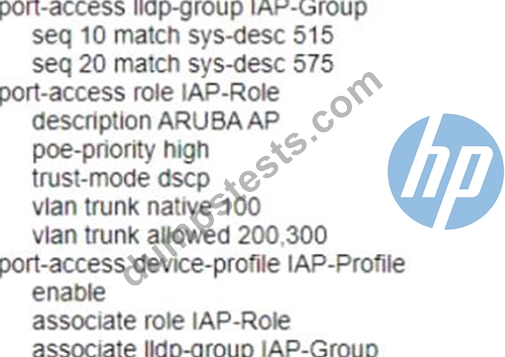
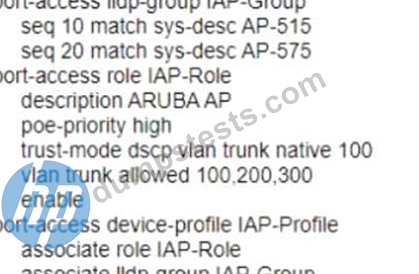
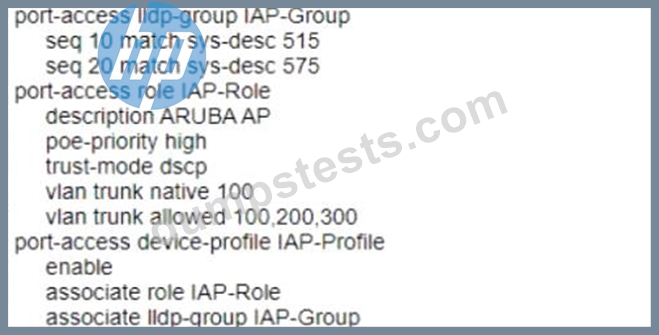
A system engineer needs to preconfigure several Aruba CX 6300 switches that will be sent to a remote office An untrained local field technician will do the rollout of the switches and the mounting of several AP-515s and AP-575S. Cables running to theAPs are not labeled.
The VLANs are already preconfigured to VLAN 100 (mgmt), VLAN 200 (clients), and VLAN 300 (guests) What is the correct configuration to ensure that APs will work properly?
- A.
- B. e ip="img_94.jpg"></e>
- C.
- D.
Answer: A
Explanation:
Explanation
Option C is the correct configuration to ensure that APs will work properly. It uses the ap command to configure a port profile for APs with VLAN 100 as the native VLAN and VLAN 200 and 300 as tagged VLANs. It also enables LLDP on the ports to discover the APs and assign them to the port profile automatically. The other options are incorrect because they either do not use the ap command, do not enable LLDP, or do not configure the VLANs correctly. References:
https://www.arubanetworks.com/techdocs/AOS-CX_10_08/UG/bk01-ch02.html
https://www.arubanetworks.com/techdocs/AOS-CX_10_08/UG/bk01-ch03.html
NEW QUESTION # 52
A new network design is being considered to minimize client latency in a high-density environment. The design needs to do this by eliminating contention overhead by dedicating subcarriers to clients.
Which technology is the best match for this use case?
- A. QWMM
- B. MU-MIMO
- C. OFDMA
- D. Channel Bonding
Answer: C
Explanation:
Explanation
OFDMA (Orthogonal Frequency Division Multiple Access) is a technology that can minimize client latency in a high-density environment by eliminating contention overhead by dedicating subcarriers to clients. OFDMA allows multiple clients to transmit simultaneously on different subcarriers within the same channel, reducing contention and increasing efficiency. MU-MIMO (Multi-User Multiple Input Multiple Output) is a technology that allows multiple clients to transmit simultaneously on different spatial streams within the same channel, but it does not eliminate contention overhead. QWMM (Quality of Service Wireless Multimedia) is a technology that prioritizes traffic based on four access categories, but it does not eliminate contention overhead. Channel Bonding is a technology that combines two adjacent channels into one wider channel, increasing bandwidth but not eliminating contention overhead. References:
https://www.arubanetworks.com/assets/ds/DS_AP510Series.pdf
https://www.arubanetworks.com/assets/wp/WP_WiFi6.pdf
NEW QUESTION # 53
A company deployed Dynamic Segmentation with their CX switches and Gateways After performing a security audit on their network, they discovered that the tunnels built between the CX switch and the Aruba Gateway are not encrypted. The company is concerned that bad actors could try to insert spoofed messages on the Gateway to disrupt communications or obtain information about the network.
Which action must the administrator perform to address this situation?
- A. Enable Enhanced security
- B. Enable Secure Mode Enhanced
- C. Enable Enhanced PAPI security
- D. Enable GRE security
Answer: C
Explanation:
PAPI is the protocol that is used to establish tunnels between the CX switch and the Aruba Gateway for Dynamic Segmentation1. By default, PAPI uses a simple checksum to verify the integrity of the messages, but it does not encrypt the payload2. This could expose the network to spoofing or replay attacks by malicious actors. To address this situation, the administrator must enable Enhanced PAPI security, which uses AES-256 encryption and HMAC-SHA1 authentication to protect the tunnel traffic2. Enhanced PAPI security can be enabled on the CX switch by using the command system papi enhanced-security enable3. This will ensure that the tunnels built between the CX switch and the Aruba Gateway are encrypted and authenticated.
NEW QUESTION # 54
With the Aruba CX switch configuration, what is the Active Gateway feature that is used for and is unique to VSX configuration?
- A. VRRP and Active gateway are mutually exclusive on a VLAN
- B. VRIDs need to be non-overlapping with VRRP
- C. VRRP and Active Gateway can be configured on a single VLAN for interoperability
- D. VRID is set automatically as SVI vlan id
Answer: A
Explanation:
Active gateway is a first hop redundancy protocol that eliminates a single point of failure. The active gateway feature is used to increase the availability of the default gateway servicing hosts on the same subnet. An active gateway improves the reliability and performance of the host network by enabling a virtual router to act as the default gateway for that network. If you have enabled active gateway, VRRP is not required3. Active gateway is similar to VRRP in that routed traffic from the VSX node is sourced from the switch interface MAC and not the virtual MAC address (VMAC). Each active gateway sends a periodic broadcast hello packet to avoid VMAC aging on the access switches. The switch views the active gateway IP as a self IP address3. Active gateway is preferable over VRRP because with VRRP traffic is still pushed over the ISL link, resulting in latency in the network3. Therefore, VRRP and active gateway are mutually exclusive on a VLAN, and answer A is correct.
NEW QUESTION # 55
You need to create a keepalive network between two Aruba CX 8325 switches for VSX configuration How should you establish the keepalive connection?
- A. SVI, VLAN trunk allowed all on ISL in custom VRF
- B. routed port in custom VRF
- C. SVI, VLAN trunk allowed all on ISL in default VRF
- D. loopback 0 and OSPF area 0 in default VRF
Answer: B
Explanation:
Explanation
To establish a keepalive connection between two Aruba CX 8325 switches for VSX configuration, you need to use a routed port in custom VRF. A routed port is a physical port that acts as a layer 3 interface and does not belong to any VLAN. A custom VRF is a virtual routing and forwarding instance that provides logical separation of routing tables. By using a routed port in custom VRF, you can isolate the keepalive traffic from other traffic and prevent routing loops or conflicts. The other options are incorrect because they either do not use a routed port or do not use a custom VRF. References:
https://www.arubanetworks.com/techdocs/AOS-CX/10.04/HTML/5200-6728/bk01-ch07.html
https://www.arubanetworks.com/techdocs/AOS-CX/10.04/HTML/5200-6728/bk01-ch02.html
NEW QUESTION # 56
What is a primary benefit of BSS coloring?
- A. BSS color tags improve performance by allowing clients on the same channel to share airtime.
- B. BSS color tags are applied to Wi-Fi channels and can reduce the threshold for interference
- C. BSS color tags are applied to client devices and can reduce the threshold for interference
- D. BSS color tags improve security by identifying rogue APs and removing them from the network.
Answer: B
Explanation:
BSS coloring is a mechanism that helps identify the BSS Basic Service Set. A BSS is a set of interconnected stations that can communicate with each other. BSS can be an independent BSS or infrastructure BSS. An independent BSS is an ad hoc network that does not include APs, whereas the infrastructure BSS consists of an AP and all its associated clients. on the same channel and differentiate them from other BSS on the same channel12. Each BSS is assigned a color code, which is a 6-bit value that is carried in the PHY header of the Wi-Fi frames12. By using BSS coloring, the APs and clients can reduce the threshold for interference detection and avoid unnecessary backoff or retransmissions when they detect frames from other BSS with different colors12. This can improve the spectral efficiency and throughput of the network12. The other options are incorrect because they do not describe the primary benefit of BSS coloring.
NEW QUESTION # 57
When setting up an Aruba CX VSX pair, which information does the Inter-Switch Link Protocol configuration use in the configuration created?
- A. UDLD
- B. RPVST+
- C. MAC tables
- D. QSVI
Answer: C
Explanation:
The information that the Inter-Switch Link Protocol configuration uses in the configuration created is B. MAC tables.
The Inter-Switch Link Protocol (ISL) is a protocol that enables the synchronization of data and state information between two VSX peer switches. The ISL uses a version control mechanism and provides backward compatibility regarding VSX synchronization capabilities. The ISL can span long distances (transceiver dependent) and supports different speeds, such as 10G, 25G, 40G, or 100G1.
One of the data components that the ISL synchronizes is the MAC table, which is a database that stores the MAC addresses of the devices connected to the switch and the corresponding ports or VLANs. The ISL ensures that both VSX peers have the same MAC table entries and can forward traffic to the correct destination2. The ISL also synchronizes other data components, such as ARP table, LACP states for VSX LAGs, and MSTP states2.
NEW QUESTION # 58
......
Download HPE7-A01 Exam Dumps Questions to get 100% Success: https://pass4sure.dumpstests.com/HPE7-A01-latest-test-dumps.html