

AD0-E134 Dumps Special Discount for limited time Try FOR FREE
AD0-E134 Dumps for success in Actual Exam Dec-2024]
Adobe AD0-E134 Exam Syllabus Topics:
| Topic | Details |
|---|---|
| Topic 1 |
|
| Topic 2 |
|
| Topic 3 |
|
| Topic 4 |
|
| Topic 5 |
|
NEW QUESTION # 34
Which OSGi configuration values can be used in an AEM as a Cloud Service Implementation?
- A. Inline, secret, runmode-specific
- B. Inline.restricted,runmode-specific
- C. Inline, restricted. environment-specific
- D. Inline, secret environment-specific
Answer: D
Explanation:
In AEM as a Cloud Service, the OSGi configuration values that can be used include Inline, secret, and environment-specific. These configurations provide flexibility and security for managing environment-specific settings and sensitive information.
* Inline Configurations: Inline configurations are directly embedded within the code and are typically used for straightforward configurations.
* Secret Configurations: Secret configurations are used to securely store sensitive information, such as passwords and API keys. These configurations are managed separately to ensure security.
* Environment-Specific Configurations: Environment-specific configurations allow you to tailor settings for different environments (e.g., development, staging, production) without changing the underlying codebase.
Example of using these configurations:
* Inline Configuration:
{
"service.url": "https://api.example.com"
}
Secret Configuration: Managed through Adobe IMS and not directly embedded in the code.
Environment-Specific Configuration:
{
"runmode": "dev",
"service.timeout": "30"
}
References:
* Managing OSGi Configurations in AEM
* Adobe IMS for Secrets Management
NEW QUESTION # 35
An application development team needs to create a multi-channel application that uses AEM as a headless CMS Which feature should be used to maintain structured data for this application?
- A. Static template
- B. Experience fragment
- C. Custom component
- D. Content fragment
Answer: D
Explanation:
A content fragment is a reusable piece of content that can be authored and managed independently from a page. Content fragments are based on structured data models that define the elements and data types of the content. Content fragments can be delivered as JSON using various APIs, such as Assets HTTP API, Content Fragments REST API, or Content Fragments GraphQL API. Content fragments are suitable for creating multi-channel applications that use AEM as a headless CMS. References:
https://experienceleague.adobe.com/docs/experience-manager-learn/foundation/headless/introduction-to-headles
NEW QUESTION # 36
An AEM application requires LDAP Service integration to synchronize users/groups. Which two OSGi configuration are required for LDAP integration in AEM? (Select Two.)
- A. Apache Jackrabbit Oak External Login Module
- B. Apache Jackrabbit Oak AuthorizableActionProvider
- C. Apache Jackrabbit Oak CUG Configuration
- D. Apache Jackrabbit Oak Default Sync Handler
- E. Apache Jackrabbit Oak Solr server provider
Answer: A,D
Explanation:
Explanation
The Apache Jackrabbit Oak External Login Module and Apache Jackrabbit Oak Default Sync Handler are the two OSGi configurations that are required for LDAP integration in AEM. The External Login Module defines how AEM connects to the LDAP server and authenticates users against it. The Default Sync Handler defines how AEM synchronizes users and groups from the LDAP server to the repository.
References:https://experienceleague.adobe.com/docs/experience-manager-65/administering/security/ldap-config.
NEW QUESTION # 37
After defining a Sling Model, what step is required to enable JSON export on any component?
- A. Annotate the Sling Model interface.
- B. Create an OSGI configuration.
- C. Use Sling Resource Merger.
- D. Install Jackson library in AEM
Answer: A
Explanation:
To enable JSON export on any component after defining a Sling Model, you need to annotate the Sling Model interface with @Exporter annotation. This annotation is part of the Sling Model Exporter framework which allows Sling Models to be exported in JSON format.
Here is the detailed step-by-step explanation:
* Define the Sling Model: Define your Sling Model with the necessary annotations and methods. For example:
@Model(adaptables = Resource.class)
public class MyModel {
@Inject
private String title;
public String getTitle() {
return title;
}
}
Annotate with @Exporter: Annotate the Sling Model class with @Exporter to enable JSON export. The
@Exporter annotation configures the model to be exported as JSON.
@Model(adaptables = Resource.class)
@Exporter(name = "jackson", extensions = "json")
public class MyModel {
@Inject
private String title;
public String getTitle() {
return title;
}
}
Access the JSON Output: Once annotated, the JSON representation of the model can be accessed through the
.model.json extension. For example, if your component is at /content/mysite/en, you can access the JSON output at:
http://localhost:4502/content/mysite/en.model.json
This approach leverages the Sling Model Exporter framework to seamlessly convert Sling Models to JSON format, making it easy to integrate with front-end frameworks and other systems that consume JSON data.
References:
* Adobe Sling Model Exporter
* AEM Core Components JSON Export
NEW QUESTION # 38
Which Maven plugin checks if all the requirements declarations made in OSGi bundles are satisfied by the capabilities declarations of other bundles included in the Maven project?
- A. content-package-maven-plugin
- B. aemanalyser-maven-plugin
- C. maven-enforcer-plugin
- D. femaven-assembly-plugin
Answer: B
Explanation:
The aemanalyser-maven-plugin is a Maven plugin that checks if all the requirements declarations made in OSGi bundles are satisfied by the capabilities declarations of other bundles included in the Maven project.
This plugin ensures that the OSGi bundles are consistent and can be resolved at runtime. The plugin also checks for other issues such as API compatibility, package versioning, and bundle start order. References:
https://experienceleague.adobe.com/docs/experience-manager-cloud-service/implementing/developing/aem-proje
NEW QUESTION # 39
Which two unit testing dependencies are generated by AEM archetype? (Select two.)
- A. Selenium
- B. Hobbes
- C. Mockito
- D. JUnit
- E. PowerMock
Answer: C,D
Explanation:
Explanation
JUnit and Mockito are two unit testing dependencies that are generated by AEM archetype. JUnit is a framework for writing and running unit tests in Java. Mockito is a framework for creating and using mock objects in unit tests. AEM archetype also adds Apache Sling Mocks and AEM Mocks Test Framework by io.wcm as dependencies for unit testing. References:
https://experienceleague.adobe.com/docs/experience-manager-learn/getting-started-wknd-tutorial-develop/projec
NEW QUESTION # 40
An AEM application has a Header and Footer authored on every page.
The customer asks for the following:
1. A centralized Header and Footer
2. The ability to create a variation for both the Header and Footer
3. Change the Header and Footer for specific time periods
4. The ability to restore a previous version for both the Header and Footer What should the developer use to meet the requirements?
- A. Static template
- B. Experience fragment
- C. Custom component
- D. Content fragment
Answer: B
Explanation:
Explanation
An experience fragment is a group of one or more components including content and layout that can be referenced within pages. Experience fragments allow authors to create variations for different channels and modify them for specific time periods. Experience fragments also support versioning and restoring previous versions.
References:https://experienceleague.adobe.com/docs/experience-manager-65/authoring/authoring/experience-fra
NEW QUESTION # 41
What is Out of Scope for the Pattern Detector tool, while doing an AEM upgrade?
- A. rep:User nodes compatibility (in context of OAuth configuration)
- B. OSGi bundles exports and imports mismatch
- C. Backward Compatibility with the previous AEM Version
- D. Definitions of Oak indices for compatibility
Answer: C
Explanation:
Backward Compatibility with the previous AEM Version is out of scope for the Pattern Detector tool, while doing an AEM upgrade. The Pattern Detector tool is a tool that scans an existing AEM code base and identifies patterns that are incompatible with AEM as a Cloud Service or newer versions of AEM on-premise.
The tool does not check for backward compatibility with older versions of AEM, as this is not a requirement for upgrading. References:
https://experienceleague.adobe.com/docs/experience-manager-cloud-service/moving/cloud-migration/pattern-det
NEW QUESTION # 42
Which property under /cache on dispatcher.any file identifies the directory where cached files are stored?
- A. /invalidate
- B. /statfile
- C. /cacheroot
- D. /docroot
Answer: C
Explanation:
The /cacheroot property under /cache in the dispatcher.any file identifies the directory where cached files are stored. It is a relative or absolute path to the cache root directory. The dispatcher creates a subdirectory for each virtual host under this directory and stores thecached files there.
References:https://experienceleague.adobe.com/docs/experience-manager-dispatcher/using/configuring/dispatche
NEW QUESTION # 43
Which attribute must be present in all filter rules in AEM dispatcher configuration?
- A. /url
- B. /type
- C. /glob
- D. /selectors
Answer: C
Explanation:
Explanation
The /glob attribute is mandatory for all filter rules in the dispatcher configuration. It specifies a pattern that is matched against the incoming request URL. If the pattern matches, the rule is applied. The /glob attribute can use wildcards (*) and placeholders ($1, $2, etc.) to match parts of the URL.
References:https://experienceleague.adobe.com/docs/experience-manager-dispatcher/using/configuring/dispatche
NEW QUESTION # 44
The following anchor tag is not resolving:
<a href="item.path" >{item.name}</a>
Upon further inspection the developer notices that the link has no .html appended to the end of the URL What could be a potential fix for the issue?
- A.

- B.

- C.

- D.

Answer: D
Explanation:
Option B is a potential fix for the issue. Option B uses the data-sly-attribute block statement to add the href attribute to the anchor tag. The data-sly-attribute statement uses an expression to append ".html" to the item.path value. This way, the link will have the correct extension and will resolve to the corresponding page.
References:https://experienceleague.adobe.com/docs/experience-manager-htl/using-htl/htl-block-statements.htm
NEW QUESTION # 45
An AEM Developer receives requirements for Sling Models in a human-readable yaml format. A custom application needs to be built. The dependency is as shown: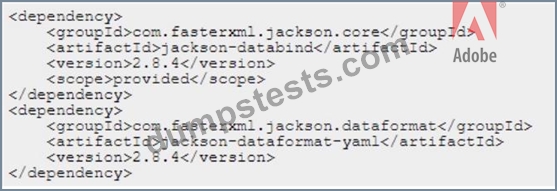
- A. 1. Create OSGI models to export as yaml
2. Configure mime type in Apache Sling Servlet/Script Resolver and Error Handler - B. 1. Create Sling models to export as yaml
2. Configure mime type in Apache Sling Referrer Filter - C. 1. Create Sling models to export as yaml
2. Configure mime type in Apache Sling MIME Type Service - D. 1. Create OSGI models to export as yaml
2. Configure mime type in Apache Sling MIME Type Service
Answer: C
Explanation:
Explanation
To create Sling Models that can export data in a human-readable yaml format, the following steps are required:
* Create Sling models to export as yaml. Sling models are Java classes that can be used to represent resources in AEM. Sling models can use annotations to define how they can be adapted from a resource and how they can export data in different formats. To export data in yaml format, the Sling model class needs to use the @Model annotation with the resourceType parameter set to the resource type of the resource that the model represents. The Sling model class also needs to implement the org.apache.sling.models.annotations.Exporter annotation with the name parameter set to "jackson" and the extensions parameter set to "yaml". The Sling model class also needs to use the @JsonProperty annotation on the fields or methods that need to be exported in yaml format.
* Configure mime type in Apache Sling MIME Type Service. The Apache Sling MIME Type Service is an OSGi service that maps file extensions to MIME types and vice versa. To enable the yaml format for Sling models, the MIME Type Service needs to be configured with a new entry for the yaml extension and its corresponding MIME type, which is "application/x-yaml". This can be done by creating an OSGi configuration for the org.apache.sling.commons.mime.internal.MimeTypeServiceImpl service and adding the entry "yaml=application/x-yaml" to the mime.types property. References:
https://sling.apache.org/documentation/bundles/models.html
https://sling.apache.org/documentation/bundles/mime-type-support-commons-mime.html
NEW QUESTION # 46
SPA components are connected to AEM components via the MapTo() method.
Which code should be used to correctly connect an SPA component called ItemList to its AEM equivalent?
- A. MapTo(ltemList)('project/components/content/itemList,,ltemListEditConfig);
- B. ItemList.MapToCproject/components/content/itemList1);
- C. MapToCproject/cornponents/content/itemList^ltemListJtemListEditConfig);
- D. ('project/components/content/itemList,).MapTo(ltemList,ltemListEditConfig);
Answer: B
Explanation:
The MapTo() method is used to map a SPA component to an AEM component by specifying the sling:resourceType of the AEM component as an argument. The MapTo() method should be called on the SPA component and not on a string. The secondargument of the MapTo() method is optional and can be used to provide an edit configuration for the SPA component.
NEW QUESTION # 47
Which query parameter needs to be added and set to true to debug a CQ HTML client library in the AEM author instance?
- A. debuggerClientLibs
- B. debugClientLibs
- C. debugClienlLib
- D. debuggerClienlLib
Answer: B
Explanation:
To debug a CQ HTML client library in the AEM author instance, you need to add the query parameter debugClientLibs set to true. This parameter instructs AEM to include additional debugging information for client libraries, making it easier to troubleshoot issues with JavaScript, CSS, and other assets.
Steps to enable client library debugging:
* Open the AEM Page: Navigate to the AEM page where you want to debug the client libraries.
* Append the Query Parameter: Add ?debugClientLibs=true to the URL. For example:
http://localhost:4502/content/we-retail/us/en.html?debugClientLibs=true
* Reload the Page: Refresh the browser page. AEM will now include debugging information for client libraries.
This parameter helps in identifying issues with client library loading, dependencies, and other client-side resources.
References:
* Debugging Client Libraries in AEM
NEW QUESTION # 48
An AEM application development team is assigned a task to create an Event-Driven Data Layer implementation for an Analytics solution.
Which Adobe recommended best practice should the developer choose?
- A. Create a custom data layer and add each component template, and its properties to the data layer
- B. Use Adobe Experience Platform's data layer to integrate with AEM.
- C. Create an Adobe Cloud Service configuration to use third-party tool's data layer.
- D. Use Adobe Client Data Layer and integrate with Core components.
Answer: D
Explanation:
Adobe Client Data Layer is a JavaScript library that provides a standardized way to collect, structure, and manage data on a web page. It can be used to implement an event-driven data layer for analytics solutions. It integrates with Core components and allows authors to configure data layer properties for each component. It also supports custom events and data sources. References:
https://experienceleague.adobe.com/docs/experience-manager-core-components/using/developing/data-layer.htm
NEW QUESTION # 49
An AEM environment is cloned, and the domain and IPs ate changed. What must be reconfigured for content activation to work?
- A. User of replication agents
- B. Transport URI of the flush and replication agents
- C. User of flush agents
- D. Transport URI in dispatcher configuration
Answer: B
Explanation:
When an AEM environment is cloned and the domain and IPs are changed, it is crucial to reconfigure the Transport URI of both the flush and replication agents to ensure content activation works correctly.
Here's the step-by-step process to reconfigure these settings:
* Access the AEM Tools Console: Log into your AEM instance and navigate to Tools > Deployment > Replication.
* Update Replication Agents:
* Go to the "Agents on author" section.
* Select each replication agent (usually named "default" or based on your custom setup).
* Edit the agent configuration.
* Update the Transport URI to reflect the new domain and IP address.
* Save the configuration.
* Update Flush Agents:
* Navigate to the dispatcher flush agents.
* Select each flush agent.
* Edit the agent configuration.
* Update the Transport URI with the new domain and IP address.
* Save the configuration.
* Test the Configuration: After updating the URIs, test the content activation process to ensure that the replication and flushing mechanisms are working correctly with the new settings.
These steps ensure that the communication paths for content replication and cache flushing are correctly established, thereby maintaining the integrity and functionality of content activation.
References:
* AEM Replication Documentation
* Dispatcher Configuration Documentation
NEW QUESTION # 50
In an AEM as a Cloud Service environment, which repository areas are considered as immutable?
- A. /apps and /libs
- B. /apps and /content
- C. /content and /etc
- D. /content and /libs
Answer: A
Explanation:
In AEM as a Cloud Service environment, the repository areas /apps and /libs are considered as immutable, meaning that they cannot be modified at runtime by any means. These areas contain application code and configuration that are deployed via Cloud Manager and are read-only for security and performance reasons.
Any changes to these areas require a new deployment via Cloud Manager. References:
https://experienceleague.adobe.com/docs/experience-manager-cloud-service/implementing/deploying/overview.h
NEW QUESTION # 51
Which practice should be used to push a code fix to make it into the current release candidate?
- A. Make the fix in CRX where the current release candidate is currently deployed.
- B. Cherry-pick the fix commit into the release candidate.
- C. Make the fix locally and upload the package to where the release candidate is deployed.
- D. Create a new release candidate from the master branch.
Answer: B
Explanation:
To push a code fix into the current release candidate, the best practice is to cherry-pick the fix commit into the release candidate branch. Cherry-picking allows you to apply specific changes from one branch to another, ensuring that only the necessary fixes are included without introducing unrelated changes.
Here's how to cherry-pick a commit:
* Identify the Commit: Locate the commit hash of the fix you need to apply. This can be found in your
* version control system (e.g., Git).
* Checkout the Release Candidate Branch:
git checkout release-candidate-branch
Cherry-pick the Commit:
git cherry-pick <commit-hash>
Resolve Conflicts(if any): If there are conflicts, resolve them manually and then continue the cherry-pick process:
git add <resolved-files>
git cherry-pick --continue
Test the Changes: Ensure that the changes are tested thoroughly in the release candidate environment to confirm the fix works as expected.
Push the Changes:
git push origin release-candidate-branch
Cherry-picking ensures that only the required changes are applied to the release candidate, maintaining the stability and integrity of the codebase.
References:
* Git Cherry-pick Documentation
NEW QUESTION # 52
Which tool should a developer use to look up Adobe Identity Management System (IMS) users by email and return their IMS IDs?
- A. User Mapping Tool
- B. IMS Lookup Tool
- C. Developer Console
- D. Cloud Acceleration
Answer: B
Explanation:
Explanation
The IMS Lookup Tool is a tool that allows looking up Adobe Identity Management System (IMS) users by email and returning their IMS IDs. The IMS Lookup Tool is available in the Cloud Manager UI under the Tools menu. The IMS Lookup Tool can be used to find the IMS IDs of users who need to be added to Cloud Manager programs or environments. References:
https://experienceleague.adobe.com/docs/experience-manager-cloud-service/implementing/using-cloud-manager
NEW QUESTION # 53
A developer has multiple LDAP Authentication providers. The user is not required to pass the authentication test of the Authentication provider
* If authentication succeeds, control is returned to the caller; no subsequent Authentication provider down the list Is executed.
* If authentication fails, authentication continues down the list of providers.
What should be the JAAS Control flag value in Apache Jackrabbit Oak External Login Module configuration?
- A. REQUIRED
- B. OPTIONAL
- C. MANDATORY
- D. SUFFICIENT
Answer: D
Explanation:
The JAAS Control flag SUFFICIENT is used when you have multiple LDAP authentication providers and you want the following behavior:
* Immediate Return on Success:
* If authentication succeeds with the current provider, control is returned to the caller immediately, and no subsequent providers in the list are executed.
* This is efficient and reduces unnecessary processing if a user's credentials are successfully authenticated by one of the initial providers.
* Continue on Failure:
* If authentication fails with the current provider, the authentication process continues down the list of providers until a successful authentication occurs or all providers are exhausted.
* This ensures that all available providers are tried before authentication is ultimately denied.
The SUFFICIENT control flag is thus well-suited for configurations where multiple authentication providers are used, and only one successful authentication is needed to grant access.
References:
* Apache Jackrabbit Oak Documentation
* JAAS Control Flags
NEW QUESTION # 54
An AEM application must process a high volume of content ingestion on the author server.
What is a key factor to optimize a design for overall performance gain for implementing workflows?
- A. Use Schedulers to run the workflows only on weekends.
- B. Allocate more RAM for the content ingestion up front.
- C. Run garbage collection every time content ingestion occurs.
- D. Use Transient workflows.
Answer: D
Explanation:
Using transient workflows is a key factor in optimizing the design for processing a high volume of content ingestion on the author server. Transient workflows do not persist their state to the repository, which significantly reduces the overhead on the JCR (Java Content Repository). This leads to improved performance and efficiency, especially under high-content ingestion scenarios.
Here's why transient workflows are beneficial:
* Reduced Repository Writes: Since transient workflows do not persist intermediate states, the number of writes to the repository is minimized. This reduces the I/O load and speeds up the processing.
* Improved Performance: By avoiding the persistence of states, transient workflows execute faster, leading to quicker content processing and less latency.
* Resource Efficiency: Transient workflows consume fewer resources compared to their non-transient counterparts, making them more efficient in handling large volumes of content.
Steps to create a transient workflow:
* Define Workflow Model: Create a new workflow model or edit an existing one in AEM Workflow console.
* Set Workflow to Transient: In the workflow model editor, set the workflow model to be transient by marking the relevant option in the workflow properties.
* Implement Workflow Logic: Add the necessary steps and logic to the workflow model, keeping in mind that intermediate states will not be saved.
* Deploy and Test: Deploy the workflow and test it under high-content ingestion scenarios to ensure optimal performance.
References:
* Adobe Experience Manager Workflows
* Best Practices for AEM Workflows
NEW QUESTION # 55
Which AEM as a Cloud Service role can configure or run pipelines?
- A. Developer
- B. Program Manager
- C. Deployment Manager
- D. DevOps
Answer: C
Explanation:
Explanation
The Deployment Manager is a role that can configure or run pipelines in Cloud Manager. The Deployment Manager can create and edit programs and environments, configure pipelines, start and cancel pipeline executions, and approve or reject deployments to production. The Deployment Manager role requires an IMS ID that is associated with the Adobe Experience Cloud product profile. References:
https://experienceleague.adobe.com/docs/experience-manager-cloud-service/implementing/using-cloud-manager
NEW QUESTION # 56
......
Accurate AD0-E134 Answers 365 Days Free Updates: https://pass4sure.dumpstests.com/AD0-E134-latest-test-dumps.html