

[2025] Use Valid New CTAL_TM_001 Questions - Top choice Help You Gain Success
CTAL_TM_001 Exam Practice Materials Collection
NEW QUESTION # 13
You are the Test Manager of a four-person test team working for a small distribution company with a single warehouse. Your team has been working with a third party development team on a new inventory management system. The company expects this system to generate approximately one million dollars per annum in profits for the company. Early in the project, various risks were identified, and steps taken to mitigate those risks.
For example, you sent your test team for training on the new system, and upgraded the test environment. There are still some lingering risks that have not been addressed, but they have been determined to have a low chance of occurring, with minimal impact if they do occur.
What would be the best option to mitigate these remaining risks? [3]
- A. Contract with the Risk Protection Insurance company to assume these risks at a cost of $500,000 per annum.
- B. Note the risks, and ignore them for now.
- C. Create a cross-functional team to work to reduce the impact and likelihood of these risks coming to fruition.
- D. Redo the project test plan to add additional testing for these risk items.
Answer: C
Explanation:
Creating a cross-functional team to address the remaining risks is the best option, as it actively involves various stakeholders in the mitigation process. This approach allows for diverse perspectives and expertise to be applied to reduce both the likelihood of the risks occurring and their potential impact, without incurring excessive costs or ignoring the risks altogether.
Reference:
The ISTQB Advanced Level Test Manager syllabus and related documents emphasize the importance of risk management throughout the testing process. It suggests that forming teams to address risks can be an effective strategy, as it leverages collective knowledge and resources to mitigate risks in a cost-effective manner
NEW QUESTION # 14
Which testing metric identifies defect density? [1]
- A. People
- B. Product
- C. Project
- D. Process
Answer: B
Explanation:
Defect density is a testing metric that measures the number of defects identified in a component or system divided by the size of the component or system (expressed in standard measurement terms, e.g., lines-of-code, number of classes or function points)1. Defect density is a product metric, as it evaluates the quality or reliability of a software product2. Therefore, option B is the correct answer. Option A is incorrect because project metrics are metrics that measure the characteristics of the software project, such as cost, schedule, effort, scope, or resources3. Option C is incorrect because process metrics are metrics that measure the characteristics of the software process, such as effectiveness, efficiency, productivity, or maturity. Option D is incorrect because people metrics are metrics that measure the characteristics of the software personnel, such as skills, experience, motivation, or satisfaction. References: 1: Defect Density | ISTQB Glossary 2: Software Testing Metrics: What is, Types & Example 3: [Project Metrics - Software Testing Fundamentals] : [Process Metrics - Software Testing Fundamentals] : [People Metrics - Software Testing Fundamentals]
NEW QUESTION # 15
Which of the following is an advantage of specifying test conditions at a detailed level? [1]
- A. Improves maintainability and reduces ownership costs for the testware
- B. Saves time
- C. Can be used to identify test coverage gaps
- D. Can be used to leverage use cases for acceptance testing
Answer: C
Explanation:
The correct answer is A. Can be used to identify test coverage gaps. This is because test conditions are the items or events of a component or system that will be verified by one or more test cases. Specifying test conditions at a detailed level can help to identify test coverage gaps, which are the areas or aspects of the component or system that are not covered by the test conditions or test cases. By identifying test coverage gaps, the test team can ensure that the testing is complete and consistent with the test objectives and scope. Test Conditions - ISTQB not-for-profit association References: Certified Tester Advanced Level Test Manager (CTAL-TM) - ISTQB not-for-profit association, ISTQB Test Manager Certification - ISTQB Exams Worldwide - ISTQB Official Registration, Test Conditions - ISTQB not-for-profit association
NEW QUESTION # 16
When closing out a defect report, which of the following developer commentaries is most likely to motivate a tester? [1]
- A. Rejected - would take too long to fix
- B. Fixed - minor usability issue, wasn't worth the time to fix it
- C. Rejected - system is functioning as designed
- D. Fixed - error in build caused compatibility issues
Answer: D
Explanation:
This developer commentary is most likely to motivate a tester because it acknowledges the tester's contribution in finding a defect that affected the product's functionality and compatibility. It also shows that the developer took the defect seriously and fixed it promptly. This commentary demonstrates respect and appreciation for the tester's work and fosters a collaborative relationship between the developer and the tester. 21 inspirational quotes about software testingWhat motivates you - Take the Motivation Test Reference:
21 inspirational quotes about software testing - Testlio
What motivates you - Take the Motivation Test | SeeMyPersonality
NEW QUESTION # 17
How does a risk based testing approach address risks in a software product? SELECT ONE OPTION
- A. By prioritizing tests according to which product risks they address.
- B. By designing tests that address only the highest risk areas.
- C. By calculating the likelihood and impact of a risk, the probability of finding defects is increased.
- D. By identifying known risks in defect reports.
Answer: A
NEW QUESTION # 18
You are a new Test Manager on a maintenance release for an existing mature product that is expected to be retired in the not too distant future. The previous release had utilized a performance regression test suite written in an in-house custom tool using the same programming language as the product itself. This suite will most likely require tweaking to ensure it works with the new version of the product. While there are several members in the performance testing team, the original author of the performance testing tool has moved on to another company, and none of the remaining staff have a great deal of familiarity with the performance test scripts used to test this product.
How would you recommend this scenario be addressed? [3]
- A. Make the in-house tool available to the open source community.
- B. Leverage the development team to fill any knowledge gaps in the in-house tool.
- C. Reduce the scope of the product testing to exclude performance testing.
- D. Retire the in-house tool and switch to a vendor supported tool for performance testing.
Answer: B
Explanation:
The best option to address this scenario is to leverage the development team to fill any knowledge gaps in the in-house tool. This option allows the test team to reuse the existing performance test suite and avoid the risks and costs of switching to a new tool or excluding performance testing altogether. The development team can provide support and guidance to the test team on how to use and modify the in-house tool, since it is written in the same programming language as the product itself. This option also preserves the intellectual property of the organization and does not expose the in-house tool to the open source community. ISTQB Advanced Level Test Manager SyllabusAdvanced Software Testing - Vol. 2 Reference:
ISTQB Advanced Level Test Manager Syllabus
Advanced Software Testing - Vol. 2, 2nd Edition
NEW QUESTION # 19
You have been assigned t o a project that has a very tight schedule. In fact, given your first analysis you do not think the planned test execution can be completed within the schedule There is no time allowed for defect fixing or for repeating tests. Regression testing has been left out of the planning entirely There is no time to develop test automation. The team has agreed that this Is not the way to run a project, yet they are stuck with the current schedule Given this information what is the best way to proceed with the testing to try to meet the deadline with the best outcome1?
- A. Review the personnel plan and get more resources onto the test team
- B. Develop a test automation plan so that automation can be started now
- C. Conduct a quality risk analysis and prioritize the testing based on risk so the highest risk items are tested first
- D. Continue with the current plan but highlight to the project manager that either the deadline will be missed or the testing will not be done
Answer: C
Explanation:
* Dealing with Tight Schedules:
* Prioritization based on quality risk ensures critical areas are tested, minimizing risks to the project.
* In tight schedules, testing everything is impractical; focus must shift to high-risk areas.
* Evaluation of Options:
* Ais unlikely feasible given the tight schedule.
* Bhighlights the issue but does not propose a solution.
* C(developing automation) is not possible given time constraints.
* Dis correct because risk-based testing ensures the best possible outcome within the constraints.
References and Syllabus Alignment:
* Risk-based testing is a core concept under "Test Process and Risk Management" in ISTQB syllabus (TM-1.3.1, TM-1.3.4).
NEW QUESTION # 20
The test team is using a distributed model for testing.
What is the primary factor you should consider with this model? [1]
- A. Co-location of test team
- B. Alignment of methodologies
- C. Provision of growth opportunities for the individual testers
- D. Planned vs. actual hours
Answer: B
Explanation:
A distributed model for testing is a testing model that involves testers working in different locations, time zones, or organizations, such as onshore, offshore, or nearshore1. The primary factor that you should consider with this model is the alignment of methodologies, which means that the testers follow the same or compatible testing processes, standards, tools, and techniques, regardless of their location, time zone, or organization2. The alignment of methodologies can help to ensure the consistency, quality, and efficiency of the testing activities, as well as to facilitate the communication, coordination, and collaboration among the testers3. Therefore, option A is the correct answer. Option B is incorrect because co-location of test team is not a factor that you should consider with a distributed model for testing, but rather a factor that is contrary to a distributed model for testing. Co-location of test team means that the testers work in the same physical location, which can have some advantages, such as easier communication, faster feedback, and stronger team spirit, but also some disadvantages, such as higher costs, limited resources, and less diversity4. Option C is incorrect because provision of growth opportunities for the individual testers is not a factor that you should consider with a distributed model for testing, but rather a factor that is relevant to any testing model. Provision of growth opportunities for the individual testers means that the testers are given the chance to learn new skills, gain new experiences, and advance their careers, which can have some benefits, such as increased motivation, productivity, and retention of the testers. Option D is incorrect because planned vs. actual hours is not a factor that you should consider with a distributed model for testing, but rather a factor that is relevant to any testing model. Planned vs. actual hours is a testing metric that compares the estimated and the actual effort spent on the testing activities, which can help to measure the accuracy of the test estimation, the efficiency of the test execution, and the variance of the test schedule. References: 1: ISTQB Glossary, Distributed Testing 2: Distributed Testing - Software Testing Fundamentals 3: ISTQB Advanced Level Test Manager Syllabus, Section 3.2.1 4: Co-located vs. Distributed Teams: What's the Difference? : How to Provide Growth Opportunities for Employees : Software Testing Metrics: What is, Types & Example
NEW QUESTION # 21
IEEE 1028 also defines "management review" as a type of review. What is the main purpose of a management review? 1 credit
- A. Align technical concepts during the design phase
- B. Provide independent evaluation of compliance to processes, regulations, standards etc.
- C. Establish a common understanding of requirements
- D. To monitor progress, assess the status of a project, and make decisions about future actions
Answer: D
Explanation:
Explanation/Reference:
Explanation:
NEW QUESTION # 22
Refer to SCENARIO 2 - You have been tasked with recruiting testers for Project 3 to help design and run regression tests, you have been provided with a skills matrix for four prospective candidates. The matrix shows the skill level (High or Low) for each candidate: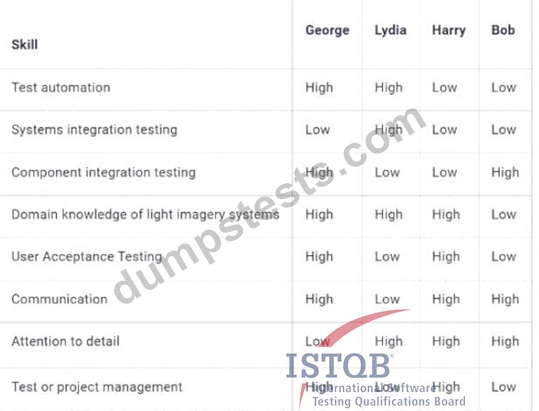
Which candidate would be the MOST suitable for a test analyst role on Project 3?
SELECT ONE OPTION
- A. Bob.
- B. Lydia
- C. George.
- D. Harry.
Answer: C
NEW QUESTION # 23
Which of the following statements is true regarding Fault Tree Analysis?
- A. It is used to select the pairs of items to be used in pairwise testing.
- B. It is a formal technique used to identify the likely effects of risks.
- C. It is used to determine the root cause of observed and potential failures.
- D. It is used to target defect-based testing.
Answer: C
Explanation:
Fault Tree Analysis (FTA) is a technique used to analyze the causes of faults (defects). The technique visually models how logical relationships between failures, human errors, and external events can combine to cause specific faults to disclose1. FTA can help to determine the root cause of observed and potential failures by tracing back the fault events to their initiating causes and identifying the combinations of events that can lead to the fault occurrence2. Therefore, option A is the correct answer. Option B is incorrect because FTA is not used to select the pairs of items to be used in pairwise testing, which is a technique to generate test cases based on the combinations of two input parameters. Option C is incorrect because FTA is not a formal technique used to identify the likely effects of risks, which are uncertain events or conditions that may have a positive or negative impact on the project objectives. Option D is incorrect because FTA is not used to target defect-based testing, which is a testing technique that uses information about the types, causes, andlocations of defects discovered in previous projects to guide the selection, creation, and prioritization of test cases. References: 1: Fault Tree Analysis | ISTQB Glossary 2: Fault Tree Analysis (FTA) - Software Testing Genius : ISTQB Glossary, Pairwise Testing : ISTQB Glossary, Risk : ISTQB Glossary, Defect-Based Test Technique : Fault Tree Analysis (FTA) - Software Testing Genius : Fault Tree Analysis | ISTQB Glossary
NEW QUESTION # 24
As a result of the RAD based development approach, the test manager has decided to change the risk mitigation approach. Which test technique might be most appropriate to use? 2 credits
- A. Decision Table Testing
- B. Exploratory Testing
- C. Boundary Value Analysis
- D. Error Guessing
Answer: B
NEW QUESTION # 25
Which work experience is likely to develop the necessary skills to effectively test a software system? [3]
- A. Being the developer of testing tools used for automation
- B. Being the current Project Manager for the system
- C. Being a former Test Manager
- D. Being a member of the production group that supported the previous release of the system
Answer: A
Explanation:
Being the developer of testing tools used for automation is likely to develop the necessary skills to effectively test a software system because it involves a deep understanding of testing processes and the creation of tools that facilitate these processes. This experience provides insight into the intricacies of test automation, which is crucial for designing effective tests and ensuring thorough coverage of the system under test.
NEW QUESTION # 26
Which three of the following would be considered a good mix of technical and interpersonal skills (hard and soft), for a test team leader?
a. Ability to compliment a developer.
b. Presenting information regarding a test project progress to stakeholders c. Using a configuration management tool.
d. Ability to read a development coding language
e. Assessing a failure and documenting it correctly.
- A. a. b and e.
- B. b, d and e.
- C. a. c and d.
- D. c. d and e.
Answer: B
NEW QUESTION # 27
Which of the following is the proper order for the stages of a tool lifecycle?
- A. Acquisition Evolution Support Retirement
- B. Evolution Acquisition Retirement Support
- C. Evolution Support Acquisition Retirement
- D. Acquisition Support Evolution Retirement
Answer: D
Explanation:
Definition of Tool Lifecycle Stages:
Acquisition: The tool is selected and procured.
Support: Maintenance and updates are provided to ensure ongoing usability.
Evolution: The tool is upgraded or adapted for new needs.
Retirement: The tool is decommissioned when no longer useful.
Evaluation of Options:
A . Acquisition Support Evolution Retirement:
Correct. This sequence reflects the natural progression of a tool lifecycle.
B . Acquisition Evolution Support Retirement:
Incorrect. Support should occur before evolution as maintenance ensures stability before upgrades.
C . Evolution Acquisition Retirement Support:
Incorrect. Evolution cannot occur before acquisition.
D . Evolution Support Acquisition Retirement:
Incorrect. Acquisition must come first.
Syllabus Alignment:
ISTQB highlights the lifecycle stages of tools in test environments as starting with acquisition and ending with retirement (TM-1.6.4).
Reference:
ISTQB Advanced Level Test Management Syllabus (TM-1.6.4)
NEW QUESTION # 28
Which of the following Is the common set of information to be produced in a test estimate''
- A. Time per person budget end date start date
- B. Effort time cost, test activities
- C. Number of people number of systems lines of code, cost
- D. Test effort test duration time to complete, cost
Answer: B
Explanation:
Key Factors in Test Estimation:
Test estimation requires identifying measurable factors that influence the testing process, including effort (workload in person-hours), time (calendar duration), cost, and the specific test activities (e.g., planning, design, execution).
These are critical to align resources and schedules, ensuring effective project management.
Evaluation of Options:
A is incorrect: While "lines of code" may relate to testing scope in specific cases, it is not universally applicable in test estimation.
B is incorrect: "Start and end dates" are outputs of planning, not estimation.
C is partially correct but lacks a focus on "test activities," which is crucial for completeness.
D is correct as it covers effort, time, cost, and test activities, reflecting a comprehensive test estimate.
Reference and Syllabus Alignment:
As per ISTQB Advanced Test Management syllabus, test estimation should consider effort, time, cost, and activities under "Test Planning" (TM-1.1.1).
NEW QUESTION # 29
Which one of the following statements correctly describes how product quality risks should be mitigated and managed? SELECT ONE OPTION
- A. The size of the test team should be proportional to the number of high priority product quality risks identified.
- B. The number of people dedicated to analysis, design and execution should be proportional to the level of risk identified.
- C. The number of test levels should address the different priorities of identified product quality risks.
- D. The amount of time dedicated to analysis, design and execution of tests should be based on the assessed level of risk.
Answer: D
NEW QUESTION # 30
Which of the following metrics would be most beneficial to collect to determine the effectiveness of a review process?
- A. The number of defects found in production for each module that was reviewed
- B. The elapsed time between each module's review and its corresponding deployment into production
- C. The development language used to create each module that was reviewed
- D. The business criticality of each module that was reviewed
Answer: A
Explanation:
The effectiveness of a review process can be measured by how well it detects and removes defects from the work products being reviewed1. One of the metrics that can indicate the defect detection capability of a review process is the number of defects found in production for each module that was reviewed2. This metric can show how many defects escaped the review process and were not detected until the software was deployed. A lower number of defects found in production means a higher review effectiveness. Therefore, option A is the correct answer. Option B is incorrect because the development language used to create each module that was reviewed is not relevant to the review process effectiveness. Option C is incorrect because the elapsed time between each module's review and its corresponding deployment into production is not a measure of defect detection or removal, but rather a measure of development speed or efficiency. Option D is incorrect because the business criticality of each module that was reviewed is not a measure of defect detection or removal, but rather a measure of risk or priority. References: 1: ISTQB Advanced Level Test Manager Syllabus, Section2.3.2 2: Software Testing Metrics: What is, Types & Example
NEW QUESTION # 31
......
Maximum Grades By Making ready With CTAL_TM_001 Dumps: https://pass4sure.dumpstests.com/CTAL_TM_001-latest-test-dumps.html