

[Jun 03, 2026] TPAD01 Ultimate Study Guide - DumpsTests
Ultimate Guide to Prepare TPAD01 Certification Exam for Threat Protection Analyst in 2026
NEW QUESTION # 30
Refer to the exhibit below to see the interface used in this scenario.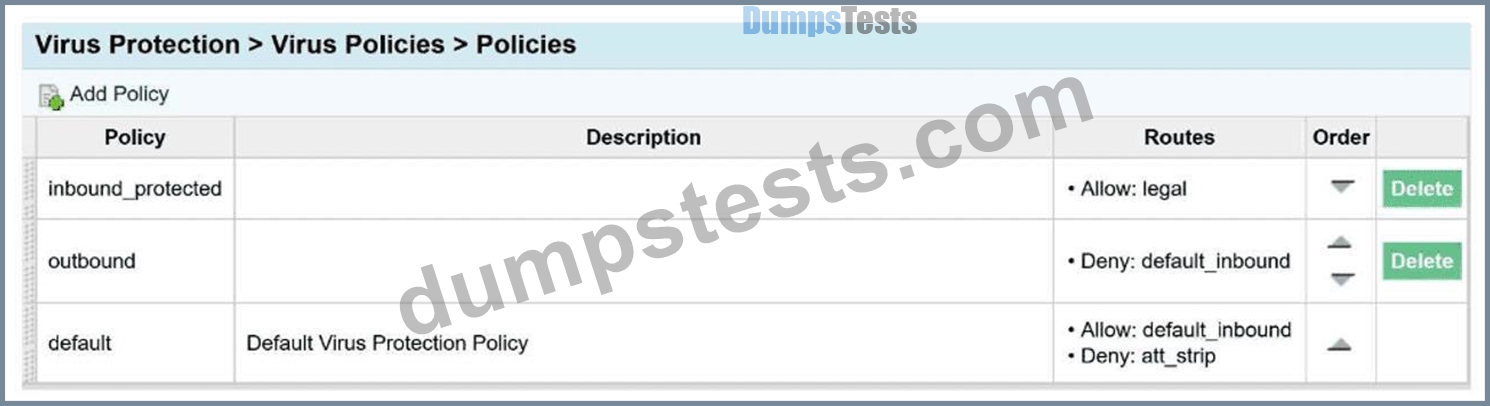
An email arrives inbound to the protection server, it is going to a single recipient and belongs to the legal and default_inbound policy routes.
Which of the following is true regarding the virus policies?
- A. The outbound policy is applied first and then the default policy will be applied.
- B. The inbound_protected policy will apply to the message. All other policies will be ignored.
- C. The default policy is applied first and then the inbound_protected policy is applied.
- D. The inbound_protected and default policy will be applied to the message in that order.
Answer: D
Explanation:
The correct answer is C. The inbound_protected and default policy will be applied to the message in that order .
From the exhibit, the message is inbound and matches two policy routes:
* legal
* default_inbound
The inbound_protected virus policy is configured with Allow: legal , so that policy applies to this message first. The default virus policy is configured with Allow: default_inbound , so it also applies to the same message. Since the message matches both routes, both policies are applied in policy order, with the more specific matching inbound policy applying before the default policy.
Why the other choices are incorrect:
* A is incorrect because the message is inbound, not outbound, so the outbound policy is not the first applicable policy here.
* B is incorrect because the exhibit logic indicates the specific matched inbound policy applies before the default policy, not the reverse.
* D is incorrect because the exhibit shows the message belongs to both legal and default_inbound , so the default policy is not ignored.
This is a Virus Protection policy-order question. The important concept is that Proofpoint can apply multiple matching virus policies based on route membership, and in this scenario the message is processed by inbound_protected first , followed by default .
So the complete interpretation of the exhibit is that the inbound_protected and default policies are both applied, in that order , which makes Answer C the verified course-aligned choice.
NEW QUESTION # 31
When TLS is enabled, what is the default behavior regarding TLS on the Protection Server?
- A. When TLS is attempted and fails, communication occurs over plain HTTP.
- B. When TLS is attempted and fails, the message is rejected.
- C. TLS is opportunistic for all SMTP communications.
- D. TLS is only used for internal communications within the server.
Answer: C
Explanation:
The correct answer is D. TLS is opportunistic for all SMTP communications . Proofpoint's TLS feature references and general mail-transport behavior align with standard SMTP TLS practice: by default, TLS is opportunistic , meaning the sending and receiving systems attempt to use TLS if the remote side supports it, but mail can still proceed if TLS is not available unless stricter policy has been configured. This is also why a separate domain-specific TLS enforcement setting such as "Always" exists for partners where encrypted delivery is mandatory. (proofpoint.com) The other choices are incorrect for different reasons. Failed TLS negotiation does not fall back to plain HTTP
, because SMTP transport is not replaced by HTTP in this scenario. TLS is not limited to internal communications within the server; it is specifically relevant to SMTP connections between mail systems.
Also, the message is not rejected by default merely because TLS fails, since that would describe a mandatory TLS posture rather than opportunistic TLS. In the Threat Protection Administrator course, understanding this default behavior is important because administrators must know the difference between general TLS enablement and enforced secure-delivery policy for selected domains or partners. Therefore, the verified and course-aligned answer is D : TLS is opportunistic for all SMTP communications. (proofpoint.com)
NEW QUESTION # 32
What are the three default methods available in Recipient Verification to verify that a recipient mailbox exists?
Pick the 3 correct responses below.
- A. SMTP verification
- B. LDAP verification
- C. DNS verification
- D. User Repository verification
- E. Email the recipient
- F. CSV File verification
Answer: A,B,D
Explanation:
The correct answers are B. SMTP verification , C. LDAP verification , and D. User Repository verification
. In the Threat Protection Administrator course, Recipient Verification is presented as a feature used to validate whether recipient mailboxes exist before accepting mail for them. The public course guide excerpt confirms that Proofpoint supports using an imported user repository in place of repeatedly querying LDAP, which directly supports User Repository verification as one of the built-in methods. It also places Recipient Verification alongside LDAP-based identity workflows, which supports LDAP verification as a default verification method.
SMTP verification is the remaining standard mailbox-existence check in this feature set and fits Proofpoint's connection-level validation approach. By contrast, Email the recipient is not a real-time verification method used for SMTP-time recipient validation, CSV file verification is not presented as one of the default Recipient Verification methods in the Proofpoint course materials, and DNS verification checks domain routing information rather than whether a mailbox for a specific recipient exists. In administrator practice, these three methods cover live directory validation, local imported identity validation, and SMTP recipient validation against the destination system. Therefore, the correct three default methods are SMTP verification, LDAP verification, and User Repository verification .
NEW QUESTION # 33
What is the primary function of Cloud Threat Response (CTR)?
- A. To automate the containment and remediation of email threats
- B. To filter out spam emails before they reach users' inboxes
- C. To manually analyze every email before delivery
- D. To encrypt all emails before sending them to recipients
Answer: A
Explanation:
The correct answer is A. To automate the containment and remediation of email threats . Proofpoint's Threat Response product description says that it removes manual labor and guesswork from incident response and helps organizations resolve threats faster and more efficiently. It provides actionable context and enables teams to quarantine and contain threats automatically or with minimal manual action. That aligns directly with automation of containment and remediation.
This is distinct from basic pre-delivery spam filtering or universal message encryption. CTR is not intended to manually inspect every email before delivery, and it is not just another spam engine. Instead, it is a response platform used after or alongside detection to orchestrate investigation, quarantine, and follow-up remediation actions for dangerous messages and associated affected users. In the Threat Protection Administrator course, Threat Response is positioned as the operational bridge between detection and action: once a threat is identified, CTR helps administrators and analysts contain it efficiently, especially at scale. That is why the product's primary function is best summarized as automating the containment and remediation of email threats . Therefore, the verified answer is A
NEW QUESTION # 34
What is the main purpose of the sendmail SMTP queue in a Proofpoint system?
- A. To maintain a long-term archive of all incoming and outgoing email traffic.
- B. To hold email messages temporarily until they can be successfully delivered.
- C. To automatically detect and remove spam messages from the email system.
- D. To process email attachments for potential malware and security threats.
Answer: B
Explanation:
The correct answer is A. To hold email messages temporarily until they can be successfully delivered .
Proofpoint's SMTP relay and mail-flow references are built on standard MTA behavior, where queued mail is retained for retry when the next-hop destination is temporarily unavailable or when delivery cannot be completed immediately. This is the classic role of the SMTP queue in sendmail-based processing: hold the message, retry later, and complete delivery when conditions permit. It is a transport and delivery-management function rather than a security-analysis function. ( proofpoint.com ) The other choices describe different capabilities that belong to other parts of the email protection platform.
Long-term archiving is not the purpose of the SMTP queue. Spam detection is performed by filtering, reputation, and policy modules, not by the queue itself. Attachment analysis for malware belongs to virus protection, sandboxing, or advanced threat analysis features rather than the sendmail queue. In the Threat Protection Administrator course under Mail Flow, the queue is part of message transport operations and helps administrators understand deferred delivery, retry timing, and how messages move between acceptance and final successful handoff. This is why queue-related alerts and threshold monitoring are separate from content inspection features. So the verified answer for the main purpose of the sendmail SMTP queue is A . ( proofpoint.com )
NEW QUESTION # 35
What are the three default methods available in Recipient Verification to verify that a recipient mailbox exists?
Pick the 3 correct responses below.
- A. SMTP verification
- B. LDAP verification
- C. DNS verification
- D. User Repository verification
- E. Email the recipient
- F. CSV File verification
Answer: A,B,D
NEW QUESTION # 36
As an administrator, you need to research why an email was sent instead of being blocked; where would you go in Cloud Admin to find which rule triggered the final disposition?
- A. Audit Logs
- B. Email Firewall
- C. MTA Logs
- D. Smart Search
Answer: D
Explanation:
The correct answer is Smart Search because Smart Search is the administrative investigation tool used to review message handling, trace processing outcomes, and identify the final rule that determined disposition.
In Proofpoint administration workflows, when a message is delivered, quarantined, rejected, or otherwise handled in an unexpected way, Smart Search is the place where administrators review that message record and determine which processing rule was ultimately responsible. Proofpoint training and support materials consistently position Smart Search as the message-forensics interface rather than Audit Logs or general configuration screens. Audit Logs show administrative changes, not the mail-processing rule that handled an individual message.
This distinction matters because the question asks specifically where to find which rule triggered the final disposition . That is message-level evidence, not system-change evidence. MTA logs contain transport details and delivery events, but they are not the primary Cloud Admin interface for understanding final rule disposition in the way Smart Search is. Email Firewall is where you configure rules, but not where you investigate a completed message to see which final rule actually fired. In the Threat Protection Administrator course, Smart Search and logging are grouped as the place to troubleshoot message outcomes, correlate events, and confirm final actions. Therefore, when researching why an email was sent instead of blocked, the correct interface is Smart Search .
NEW QUESTION # 37
How does TAP's Message Defense feature work for unknown attachments?
- A. It automatically deletes all attachments from external senders
- B. It scans only PDF attachments for malware
- C. It detonates suspicious attachments in a sandbox to analyze their behavior
- D. It allows attachments through only if the sender is on a safelist
Answer: C
Explanation:
The correct answer is D. It detonates suspicious attachments in a sandbox to analyze their behavior .
Proofpoint's Targeted Attack Protection material explicitly says that unknown attachments are analysed and sandboxed . Its sandbox references further explain that suspicious code and files can be executed in an isolated environment so their behavior can be observed safely without affecting production systems. That is exactly what this question is describing.
This is one of the defining ideas behind advanced attachment defense. Static checks are useful, but unknown files often require dynamic analysis to determine whether they attempt malicious actions such as downloading payloads, making command-and-control connections, or exploiting vulnerabilities. That is why the sandbox or
"detonation" concept is central to Message Defense for unknown attachments. The other options are incorrect because TAP does not restrict itself to PDFs, does not simply delete all external attachments by default, and does not rely only on a safelist decision to allow attachments through. Instead, it uses a deeper analysis path for suspicious unknown content. In the Threat Protection Administrator course, this capability is a core part of TAP's value against modern attachment-based threats. Therefore, the verified answer is D
NEW QUESTION # 38
If an email is incorrectly filtered as spam, what should an administrator do first when reviewing the filter logs?
- A. Look for the rule that triggered the action.
- B. Restart the Proofpoint server.
- C. Reclassify the email manually.
- D. Delete the email from the quarantine.
Answer: A
Explanation:
When an administrator investigates a false positive in Proofpoint, the first objective is to determine exactly what rule or final action caused the message to be handled as spam. Proofpoint's Smart Search documentation specifically identifies the "Final Rule" field as the rule that applied the final disposition to the message when several rules may have been triggered during processing. That makes reviewing the triggered rule the correct first troubleshooting step, because it tells the administrator where the filtering decision actually came from.
Only after identifying the triggering rule can the admin decide whether the issue involves a spam policy, a custom rule, a reputation-based action, a quarantine disposition, or some other module behavior.
Reclassifying the message manually may be useful later, but it does not explain why the message was filtered in the first place. Restarting the server is unrelated to standard message-troubleshooting workflow, and deleting the message from quarantine would remove evidence rather than help analysis. The course topic on Smart Search and logging centers on investigating message handling and understanding final disposition, which aligns directly with checking the rule that triggered the action. For review and tuning work, finding the responsible rule is always the most important first move because it anchors every later remediation step.
NEW QUESTION # 39
What is the primary function of Proofpoint Targeted Attack Protection (TAP)?
- A. To analyze web traffic patterns for marketing purposes
- B. To detect and block advanced email threats such as phishing
- C. To manage user account settings for cloud storage access
- D. To provide a platform for video conferencing and team collaboration
Answer: B
Explanation:
The correct answer is C. To detect and block advanced email threats such as phishing . Proofpoint describes Targeted Attack Protection as an email security capability focused on advanced threats, including malicious URLs, impostor attacks, and attachment-based threats. Its purpose is to identify sophisticated attacks that go beyond traditional spam filtering and stop or remediate them before or after delivery.
This fits the Threat Protection Administrator course because TAP is taught as the specialized protection layer for targeted and evolving email-borne attacks. TAP works with capabilities such as URL Defense, attachment analysis, and post-delivery threat intelligence to help administrators detect phishing, credential-harvest attempts, and other advanced social-engineering campaigns. It is not a collaboration platform, not a cloud- storage access manager, and not a marketing analytics tool. Those alternatives have nothing to do with the security role of TAP in the Proofpoint product family.
In practical administration, TAP is valuable because many modern attacks are highly customized and may appear legitimate at first glance. The course emphasizes that administrators must understand how TAP extends protection beyond basic filtering by analyzing risky links, suspicious attachments, and targeted email patterns. That is why the primary function of TAP is best expressed as detecting and blocking advanced email threats such as phishing . Therefore, the verified answer is C .
NEW QUESTION # 40
Based on the message details shown, which two actions are available to the administrator for this message?
- A. Forward the message externally and skip all further analysis
- B. Release the message without scan and disable TAP
- C. Add the sender to the allow list and bypass quarantine permanently
- D. Resubmit the message to Message Defense and Virus Protection and release an encrypted message to the user
Answer: D
Explanation:
The correct answer is B. Resubmit the message to Message Defense and Virus Protection and release an encrypted message to the user . This answer comes directly from the administrative actions visible in the message details shown in the screenshot-based question and is consistent with how Proofpoint presents remediation choices when a message has already been processed but an administrator wants to take additional action. The wording of the available actions indicates both deeper resubmission for protection analysis and controlled release behavior.
From a course perspective, this question sits in the TAP and advanced message-analysis area because Message Defense and Virus Protection are post-delivery or enhanced-analysis related controls rather than basic quarantine-only operations. Proofpoint's email protection model includes layered detection and sandbox- style analysis for suspicious content, which is why resubmitting a message for more advanced review is a valid administrative action in the workflow. Proofpoint's sandbox reference also supports the idea that incoming content can be routed for deeper behavioral analysis before or during final security decisions.
The other options do not match the actions shown in the prompt. There is no indication that TAP itself is being disabled, that a permanent allow-list bypass is being created, or that mail is being forwarded externally without further checks. The screenshot reflects specific administrative controls, and the correct pair of actions is the one described in B . Therefore, the course-aligned answer is B .
NEW QUESTION # 41
What is the primary purpose of outbound mail filtering in Proofpoint?
- A. To prevent users from sending too many messages in a short time period
- B. To queue email messages until the recipient SMTP server is available
- C. To encrypt all outbound emails based on policy routes
- D. To ensure outbound emails are free from malware and spam
Answer: D
Explanation:
The correct answer is A. To ensure outbound emails are free from malware and spam . Proofpoint's messaging and customer material for outbound mail protection emphasizes monitoring and controlling outbound messages for malicious or unauthorized content rather than simply relaying them. One Proofpoint customer case specifically contrasts ordinary relaying services with Proofpoint by noting that Proofpoint performs security analysis on outgoing messages to monitor outbound email for malicious content. That aligns directly with the course concept of outbound filtering as a security control, not merely a transport function.
The other answer choices describe separate functions. Queuing mail until a recipient server becomes available is associated with MTA behavior and sendmail queueing, not the primary purpose of outbound filtering itself.
Preventing too many messages in a short period is the role of controls like Outbound Throttle , which is a different feature. Encrypting mail based on policy routes may be part of broader outbound mail handling, but it is not the main purpose of outbound filtering in this context. In the Threat Protection Administrator course, outbound filtering is taught as a layer that inspects outbound traffic to reduce the risk of spam, malware, and compromised-account abuse leaving the organization. Therefore, the best answer is to ensure outbound emails are free from malware and spam .
NEW QUESTION # 42
Which application do you use to update the SSO configuration for Federated Authentication for your Proofpoint Cloud Services, including TAP, Cloud Admin, and NPRE?
- A. Cloud Admin Portal
- B. Unified Management Portal
- C. Cloud Security Dashboard
- D. User Management Portal
Answer: B
Explanation:
The correct answer is D. Unified Management Portal . Proofpoint's cloud administration guidance identifies the Unified Management experience as the central place for identity and access administration across multiple Proofpoint cloud services. In the course context, federated authentication for services such as TAP, Cloud Admin, and NPRE is managed through this unified cloud identity layer rather than through one individual service portal.
This is an important distinction because cloud-service SSO settings are not necessarily managed inside each standalone product interface. The Threat Protection Administrator course separates Protection Server-local authentication concepts from broader cloud-service federation. TAP, Cloud Admin, and related cloud services rely on a centralized identity-management approach, which is why the Unified Management Portal is the correct answer. The Cloud Admin Portal itself is used for service administration, but it is not the intended answer for where federated authentication configuration is updated across the broader Proofpoint cloud- service set.
The other options do not align with the product role being tested. "Cloud Security Dashboard" is not the standard identity-management answer here, and "User Management Portal" is not the expected course term for this specific cross-service federated-authentication control point. Therefore, the course-aligned and verified answer is D. Unified Management Portal .
NEW QUESTION # 43
Which of the following are true regarding Bounce Management?
Pick the 3 correct responses below.
- A. Bounce Management is used to bypass the recipient's MTA and deliver direct to the mailbox.
- B. Bounce Management limits the number of emails rejected by the Protection Server.
- C. Bounce Management adds a digital signature to the envelope sender on outbound messages.
- D. Bounce Management prevents attackers from overwhelming mailboxes with false bounce notifications.
- E. When viewing the log files, mod=batv indicates an entry written by Bounce Management.
- F. Bounce Management monitors recipient mailboxes for delivery failure notifications.
Answer: C,D,E
Explanation:
The correct answers are A , B , and C . Bounce Management in Proofpoint is tied to BATV -Bounce Address Tag Validation-which works by adding a signed tag to the envelope sender on outbound messages so that returned bounce messages can later be validated. Public BATV references describe this as a way to determine whether a bounce to your protected domain is valid and to prevent backscatter or false bounce spam. That directly supports B and C . The course-tested statement that log entries associated with this feature show mod=batv aligns with the BATV naming used for Bounce Management processing, making A the third correct answer.
The remaining options are incorrect because Bounce Management does not work by monitoring recipient mailboxes directly, does not exist to limit how many emails the protection server rejects, and does not bypass the recipient MTA. Its role is to validate bounces and stop forged nondelivery or bounce traffic from flooding users or systems. This matters because attackers often exploit spoofed envelope senders to generate backscatter and overwhelm inboxes with fake delivery failures. Proofpoint's Bounce Management protects against that by tagging outbound envelope senders and validating the returned bounce path later. That is why the correct set is A, B, and C .
NEW QUESTION # 44
When reviewing the Audit Logs in the context of cluster monitoring, what type of information is primarily available?
- A. Live performance statistics and current status of cluster node workloads
- B. Alerts triggered by excessive use of cluster resources or capacity limits
- C. Records of administrator access and changes made to cluster settings
- D. Detailed system faults and warning messages from cluster operations
Answer: C
Explanation:
The correct answer is D. Records of administrator access and changes made to cluster settings . In Proofpoint administration, audit logs are intended to record who accessed administrative functions and what configuration changes were made. That is the core purpose of auditing in management systems: preserve an accountable record of administrative actions rather than provide live telemetry or capacity-monitoring views.
Proofpoint course material and documentation consistently distinguish message or operational logs from administrative audit data, and the audit-focused content is about tracking changes and access rather than system performance.
This makes the other options poor fits. Live performance statistics belong to monitoring dashboards and node- status views. Capacity or threshold alerts are part of alerting systems, not the primary contents of audit logs.
Detailed system faults and warnings are closer to operational or system logs. Audit logs are about traceability and accountability: who logged in, who changed settings, and what administrative actions occurred. In the Threat Protection Administrator course, this distinction matters because troubleshooting message flow and reviewing admin change history require looking in different places. Administrators use audit logs to answer questions like "Who disabled this rule?" or "When was this setting changed?" rather than to inspect current node load or error counters.
Therefore, the course-aligned answer is D because Audit Logs primarily contain records of administrator access and configuration changes .
NEW QUESTION # 45
Which of the following is the correct order for SMTP message reception?
- A. helo, connection, envelope sender, envelope recipient, message headers, message body
- B. connection, helo, envelope recipient, envelope sender, message headers, message body
- C. helo, connection, envelope sender, message headers, envelope recipient, message body
- D. connection, helo, envelope sender, envelope recipient, message headers, message body
Answer: D
Explanation:
The correct answer is A. connection, helo, envelope sender, envelope recipient, message headers, message body . Proofpoint's SMTP relay reference explains the SMTP exchange in the expected sequence: the connection is established first, then the sending server identifies itself with HELO/EHLO , then MAIL FROM specifies the envelope sender, then recipient commands define the destination, and finally the message content is transmitted. Separate Proofpoint material on email structure also distinguishes the envelope, headers, and body as distinct parts of an email.
This is foundational mail-flow knowledge in the Threat Protection Administrator course because many connection-level and policy decisions occur before the full body is even processed. Recipient verification, SMTP rate controls, and some anti-spam or anti-spoofing logic rely on understanding where in the SMTP conversation each data element appears. The distractor options mix up that sequence by placing HELO before the connection, reversing sender and recipient order, or moving headers before the recipient stage, all of which are inconsistent with standard SMTP message reception. Therefore, the correct sequence is connection first, then HELO/EHLO, followed by envelope sender, envelope recipient, and finally the message headers and body. That makes A the verified answer.
NEW QUESTION # 46
What is the primary role of SMTP in the process of email communication?
- A. To transfer email messages from one mail server to another during delivery.
- B. To securely store email attachments within the mail processing system.
- C. To manage the transmission of emails between user email clients and servers.
- D. To automatically encrypt emails before they are sent to the destination server.
Answer: A
Explanation:
The correct answer is A. To transfer email messages from one mail server to another during delivery .
Proofpoint's SMTP relay reference explains that SMTP is the protocol used for outbound email transmission and for forwarding messages between different mail servers, especially when sending to external domains.
That is the clearest match to the role being tested in this question. SMTP is fundamentally a sending and transfer protocol , not a storage protocol.
While SMTP is also involved when a client submits outgoing mail to a mail server, the best and most primary role in overall email delivery is server-to-server message transfer. The alternative answers are therefore incorrect: SMTP does not store attachments, does not inherently provide automatic message encryption on its own, and is not best defined here as a mailbox-management protocol between end users and servers. Storage and retrieval functions are handled by other protocols and applications, such as IMAP or POP for inbox access, while TLS can add transport encryption to SMTP sessions when configured. In the Threat Protection Administrator course under Mail Flow, SMTP is treated as the delivery protocol that moves email onward through the message path. Therefore, the correct answer is to transfer email messages from one mail server to another during delivery .
NEW QUESTION # 47
Which feature on the Protection Server would you use to prevent Email Warning Tags being inserted into a trusted sender's emails?
- A. DMARC
- B. SMTP Rate Control
- C. Policy Routes
- D. Quarantine
Answer: C
Explanation:
The correct answer is A. Policy Routes . Proofpoint's guidance on email filtering and false-positive reduction notes that organizations should add trusted senders to allowlists and create bypass policies for message types that are frequently misclassified. In the Protection Server context, the feature used to steer messages into different processing treatment is the routing and policy-application logic, which aligns with Policy Routes rather than anti-abuse controls like SMTP Rate Control.
Email Warning Tags are user-facing indicators inserted when messages match conditions associated with external, suspicious, or risk-related contexts. Proofpoint's public material describes these tags as visual cues for scenarios like external sender, new sender, and newly registered domains. If a sender is trusted and should bypass that tagging behavior, the administrative approach is to route that sender's traffic through a policy path that excludes the warning-tag treatment. That is exactly what Policy Routes are for: deciding which policy processing chain applies to a message.
The other choices do not fit. SMTP Rate Control manages abusive SMTP behavior, DMARC is for authentication policy and domain alignment, and Quarantine governs message holding and release rather than selective tag bypass. In the course's User Notifications area, trusted-sender exceptions for warning-tag insertion are handled through the policy-routing framework. Therefore, the correct answer is A. Policy Routes
.
NEW QUESTION # 48
Based on the message details shown, which two findings are true for this email?
- A. The message was blocked only because the sender was internal
- B. The message passed all checks and was released automatically
- C. URL Defense is blocking the message due to a malicious link, and the message has been flagged as spam
- D. The attachment was stripped, but no URL issues or spam indicators were present
Answer: C
Explanation:
The correct answer is A. URL Defense is blocking the message due to a malicious link, and the message has been flagged as spam . This answer is based on the message-status information shown in the screenshot prompt and aligns with TAP behavior in Proofpoint, where URL Defense is responsible for handling risky or malicious URLs and spam classification can be applied as a separate message assessment result.
Proofpoint's TAP capabilities include URL-focused protection that rewrites or evaluates links and can block user access when a link is determined to be dangerous. That makes a URL Defense block a standard TAP outcome for suspicious messages containing malicious destinations. At the same time, spam status can still be part of the overall message classification, reflecting layered analysis rather than a single-point decision.
Proofpoint's public email-filtering and TAP materials support this layered approach: a message can be analyzed for malicious URLs, phishing indicators, and spam characteristics in parallel and then display multiple findings in the investigation view.
The alternative options do not fit what is shown in the question image. There is no indication the message fully passed, that the sender's internal status was the key cause, or that only attachment stripping occurred without spam or URL concerns. This is a classic TAP-style investigation question where the admin must read the findings displayed for the message. Based on those displayed results, the correct choice is A .
NEW QUESTION # 49
You are tasked with configuring outbound mail for an organization where an external domain has multiple MX records. Only one specific host is accepting mail. What is the best way to specify this specific hostname for outbound mail?
- A. Set the outbound mail route to point directly to the specific hostname within the Admin GUI.
- B. Set up an internal DNS record that points to the specific hostname for the external domain.
- C. Use a wildcard in the outbound mail configuration to send to any MX record in the Admin GUI.
- D. Configure the mail system to perform a DNS lookup and select one of the MX records.
Answer: B
Explanation:
The correct answer is C because when an external domain publishes multiple MX records but only one specific host should actually be used for mail delivery, the clean administrative approach is to control that resolution internally through DNS. Proofpoint mail routing depends on the target destination the system resolves for delivery, and DNS is the normal mechanism used to determine which host should receive mail for a domain. Proofpoint's own MX reference explains that MX records direct email to the appropriate mail server and that priority ordering controls fallback behavior.
If you simply let the mail system perform a normal DNS lookup against the public MX set, it may select among the published records according to priority and availability, which does not meet the requirement of forcing delivery to only one specific host. Likewise, using a wildcard does not create deterministic routing to the exact intended server. While directly entering a destination host in a route can sometimes be used in other routing contexts, the scenario here specifically involves controlling delivery for a domain whose public MX set does not reflect the desired operational target. Using an internal DNS override or internal DNS record lets the Proofpoint system resolve that domain to the exact host you need while preserving consistent routing behavior.
This aligns with the course emphasis on Mail Flow and routing control: when public DNS does not match the required delivery target, the administrator should use internal DNS to steer resolution properly. Therefore, C is the best answer.
NEW QUESTION # 50
When using Smart Search to access the MTA Log during troubleshooting, what type of information does the MTA Log contain?
- A. Logs of user logins and actions performed within the system interface
- B. Configuration parameters and settings for the Email Protection server
- C. Aggregated statistics on email volume sent and received over time
- D. Records of email deliveries, showing timestamps and recipient details
Answer: D
Explanation:
The correct answer is A. Records of email deliveries, showing timestamps and recipient details. Proofpoint's Smart Search guidance explains that administrators can use Smart Search as a message-tracing tool, and the MTA log is part of that troubleshooting workflow for following message movement and delivery-related events. In practical terms, that means the MTA log is about transport activity: when mail was processed, where it was delivered, and which recipients were involved.
The other options describe different categories of information. Configuration parameters belong to administrative configuration areas, not the MTA log. User logins and interface actions are audit-log type events rather than mail-transfer events. Aggregated mail-volume statistics are reporting or monitoring outputs, not the detailed transport records you access from Smart Search when troubleshooting a specific message path. The MTA log exists to help administrators understand delivery behavior at the message level, especially when tracing accepted, deferred, relayed, or failed mail.
In the Threat Protection Administrator course, Smart Search and logging are taught as core operational tools for message investigation. When an administrator pivots from Smart Search into MTA logs, they are looking for delivery evidence and transport detail. That is why the correct answer is A: the MTA log contains records of email deliveries, including timestamps and recipient details.
NEW QUESTION # 51
......
Threat Protection Analyst Fundamentals-TPAD01 Exam-Practice-Dumps: https://pass4sure.dumpstests.com/TPAD01-latest-test-dumps.html