

Authentic NCP-MCA Dumps With 100% Passing Rate Practice Tests Dumps
Nutanix NCP-MCA Real Exam Questions Guaranteed Updated Dump from DumpsTests
New Way To Prepare For Your Nutanix NCP-MCA Exam
Is Nutanix NCP-MCA Exam worth it?
Read Our Nutanix NCP-MCA Exam Guide That Will Help You Pass in First Try
Have you been searching for the ultimate guide for your Nutanix NCP-MCA exam? Are you fed up with googling for hours trying to prepare for your Nutanix NCP-MCA exams? Well, we have good news for you. Our experts have come together to bring you the ultimate resource that will help prepare and familiarize yourself with all aspects of the Nutanix NCP-MCA tests. Pop some popcorn, take out your phone, or sit down on your computer, because you are about to embark on a journey that will change your career forever.
When you know the right sources, then it becomes easier to pass your Nutanix examination with flying scores. Our Nutanix NCP-MCA exam dumps will lead you swiftly towards your goal of a 100% passing score.
Nutanix NCP-MCA Certification Exam is a vendor-neutral certification that is recognized globally. It is designed for professionals who are interested in advancing their careers in the field of multicloud automation. Nutanix Certified Professional - Multicloud Automation (NCP-MCA) v6.5 Exam certification exam covers a wide range of topics including Nutanix Calm, Nutanix Flow, and Nutanix Xi. Candidates are required to demonstrate their ability to use these technologies to automate the deployment and management of multicloud environments.
NEW QUESTION # 103
A DevOps team created a Calm blueprint that includes the scale-out of the application layer (made with Linux VMs). Now the DevOps team would like to automate the scale-out using a third-party tool so they can further automate the CI/CD environment with a single command.
Which action should the administrator take to accomplish this task?
- A. Create script to run the Calm scale out action.
- B. Create a Playbook with a webhook as a trigger and a REST API call as an action
- C. Configure an alert to notify the administrator.
- D. Contact professional services to modify the third-party tool to add the Calm integration.
Answer: B
Explanation:
The best way to automate the scale-out of the application layer using a third-party tool is to create a Playbook with a webhook as a trigger and a REST API call as an action. A webhook is a mechanism that allows a third-party service to send a notification to a Calm server when a certain event occurs, such as a code commit or a build completion. A REST API call is a way to interact with the Calm server programmatically, such as launching a blueprint or scaling out a service. By creating a Playbook that combines these two elements, the administrator can enable the third-party tool to trigger the scale-out action on the Calm server with a single command. The other options are either not feasible, not efficient, or not relevant for this task. Reference: Nutanix Calm: Playbooks - Read the Docs and Nutanix Calm: REST API - Read the Docs.
NEW QUESTION # 104
Where would a Calm administrator find the archived application logs within Prism Central?
- A. Services > Calm > Settings
- B. Services > Calm > Projects
- C. Services > Calm > Blueprints
- D. Services > Calm > Applications
Answer: A
Explanation:
The archived application logs within Prism Central can be found under Services > Calm > Settings. Calm automatically archives run logs of the deleted applications and custom actions that are older than three months. The administrator can download the archives within 7 days from the time of archive creation. For a running application, data is not archived for the system-generated Create actions. Reference: Nutanix Support & Insights
NEW QUESTION # 105
An administrator at a busy software development company is looking to roll out Calm for automation and estimates they will be creating 200 Projects, 500 Runbooks, 1500 Blueprints and automating the deployment of 7500 VMs for their development teams.
What size of Prism Central VM(s) is recommended to host the Calm environment?
- A. 1 node Large - 10vCPU and 52GB Memory per node.
- B. 1 node Small - 6vCPU and 30GB Memory per node.
- C. 3 nodes Small - 6vCPU and 30GB Memory per node.
- D. 3 nodes Large - 10vCPU and 52GB Memory per node.
Answer: D
Explanation:
According to the Nutanix Multicloud Automation Administration (NMCAA) course, the recommended Prism Central VM size depends on the number of VMs that are managed by Calm and the number of concurrent users. For a large-scale environment with more than 5000 VMs and more than 100 concurrent users, the recommended size is 3 nodes Large - 10vCPU and 52GB Memory per node1. This size provides enough resources for the Prism Central cluster to handle the workload and performance requirements of Calm.
Reference:
Nutanix Multicloud Automation Administration (NMCAA) course, Module 2: Nutanix Calm Installation and Configuration, Lesson 2: Nutanix Calm Installation and Configuration2 Nutanix Certified Professional - Multicloud Automation (NCP-MCA) v6.5 Exam Blueprint Guide, Section 2: Deploy and Configure Self-service and Related Components, Objective 2.2: Identify required configuration settings for a Self-Service deployment3 Scaling out Prism Central | Nutanix Community1
NEW QUESTION # 106
An administrator wants to create a blueprint for a development environment that uses an existing on-premise GitLab repository. Every new development environment requires a new user in the GitLab repo.
Which two tasks should the administrator perform within a Calm blueprint to automate this process? (Choose two.)
- A. Add a task within the service in order to ask for user and password at runtime.
- B. Create an HTTP pre-create task to create the user in GitLab via REST API.
- C. Create a task script in order to login with ssh to GitLab and create a random user and password.
- D. Create runtime-editable variables for user and password in the blueprint.
Answer: B,D
NEW QUESTION # 107 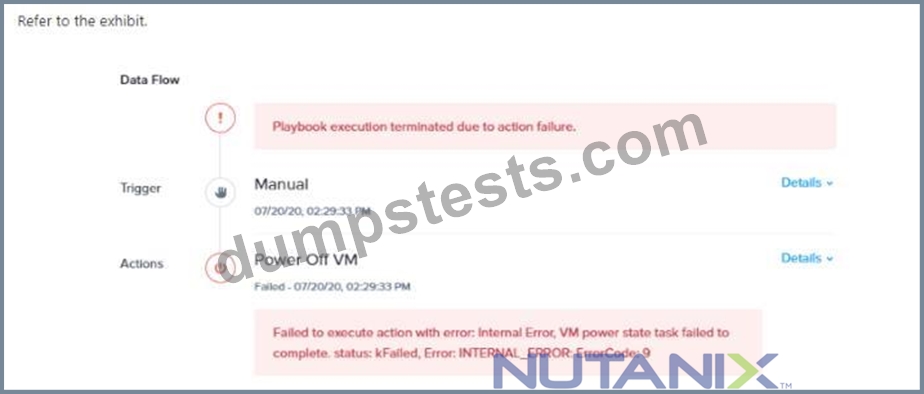
A subset of Linux VMS is required to be gracefully shutdown each evening. A Playbook is created to shut down the targeted VMs, however, the error message shown in the error message when the Playbook is executed.
Data flow
Playbook execution terminated due to action failure.
Trigger
Manual
Action
Power of vm
Error message Failed to with Internal Error. VM power state task failed to complete. status: Error:
INTERNAL_ERROR: Errorcode: 9
What is causing the error message?
- A. The SSH Service is not running on the VMs.
- B. executing the not have privileges.
- C. The VM is Off.
- D. The VM is missing Nutanix Guest Tool.
Answer: A
Explanation:
The error message "INTERNAL_ERROR: ErrorCode: 9" typically indicates an issue with the SSH service on the VMs. In this context, where a playbook is being executed to shut down Linux VMs, it's essential that the SSH service is running to allow for remote management and execution of commands. If the SSH service isn't running, the playbook won't be able to execute commands on the VMs, leading to an internal error.
References:
* Nutanix Multicloud Automation Administration (NMCAA) Course, Module 3: X-Play, Lesson 3.3:
Creating and Managing Playbooks, Slide 19: Action Settings
* Nutanix Certified Professional - Multicloud Automation (NCP-MCA) Exam Blueprint Guide, Section 3:
Validate Blueprints, Playbooks, and Automation Settings, Objective 3.3: Determine the correct method to validate required Playbook configurations
NEW QUESTION # 108
Which two items are required to create a Category via automation? (Choose two.)
- A. Value
- B. Tags
- C. Name
- D. Purpose
Answer: A,C
NEW QUESTION # 109
An administrator on a routine basis has been manually growing vDisks on multiple classes of VMs that consists of the below:
* Four MS SQL will AAG configuration
* Ten application servers
* Each server is mapped to a category
There is a direct correlation between the database sellers and application severs to when the vDsks need to be grown. The administrator has started to explore ways to automate these manna steps and has decided to implement Nutanix Playbooks.
Requirements:
* Never needs to modify the playbook as the number of servers change.
* Has to be able to specify the playbook to trigger based on when the servers (each 85% or above threshed.
* Needs to be able to receive an email prior to work starting
In which order should the administrator execute these actions when creating a playbook in order to grow the VM vDisk?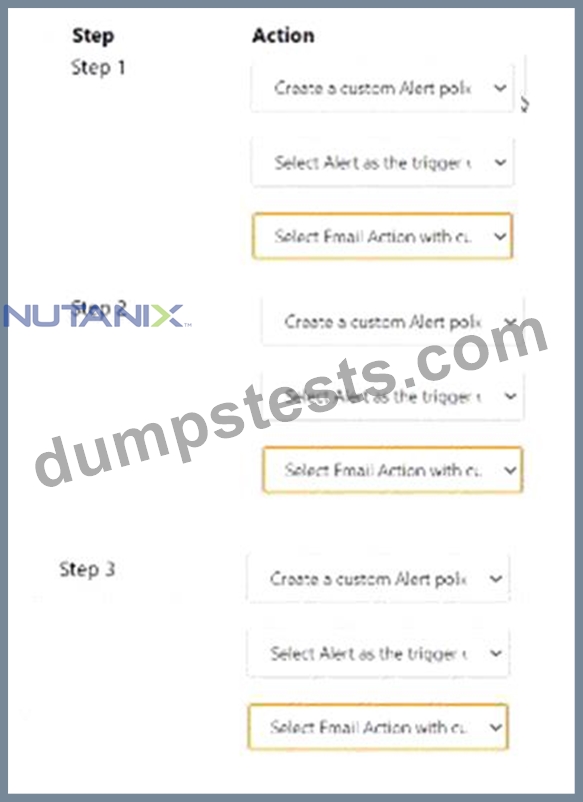
Answer:
Explanation: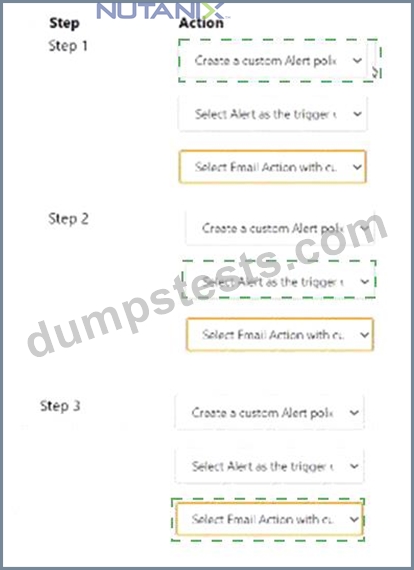
Explanation: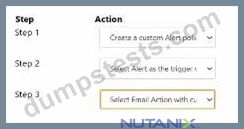
To automate the task of growing vDisks on multiple classes of VMs using Nutanix Playbooks, the administrator should follow these steps:
* Create a custom Alert Policy:
* Create an alert policy that triggers when the server's disk usage reaches 85% or above. This ensures the playbook is triggered based on the specified threshold.
* Select Alert as the trigger:
* Set the alert created in step 1 as the trigger for the playbook. This ties the alert condition to the execution of the playbook.
* Select Email Action with custom message:
* Add an action to send an email notification. This email should be sent prior to any work being started, to inform relevant stakeholders about the impending vDisk growth operation.
* Add Action to Grow vDisks:
* Add the action to grow the vDisks on the VMs. This step should include the necessary script or task that performs the vDisk growth operation on the specified VMs.
Based on the requirements and steps, the playbook should be structured as follows:
Step 1: Create a custom Alert Policy
* Define the alert policy with the condition that disk usage on the VMs reaches 85% or higher.
Step 2: Select Alert as the trigger
* Use the alert policy created in Step 1 as the trigger for the playbook.
Step 3: Select Email Action with custom message
* Add an email action to notify relevant stakeholders before the vDisk growth task is initiated.
Step 4: Add Action to Grow vDisks
* Include the necessary action to grow the vDisks on the VMs as required.
This structure ensures that the playbook is dynamically responsive to changes in server usage, sends notifications prior to execution, and performs the required vDisk growth operation automatically.
NEW QUESTION # 110
Exhibit.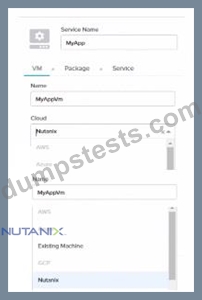
A Blueprint Developer has been asked to Create a Application Blueprint for AWS and Azure.
Which two actions must be complete to enable the developer to complete this requested task? (Choose two.)
- A. Enable Environment for AWS and Azure.
- B. Add the provider Accounts to the project.
- C. Select a public image in the region.
- D. Create AWS and Azure Accounts.
Answer: B,D
Explanation:
To create an application blueprint for AWS and Azure in Nutanix Calm, the Blueprint Developer needs to complete the following actions:
* Create AWS and Azure Accounts: These accounts must be created and configured within Nutanix Calm to allow integration with the respective cloud providers.
* Add the provider Accounts to the project: Once the accounts are created, they need to be added to the specific project in which the blueprint will be developed. This ensures that the blueprint can use the resources and configurations associated with these accounts.
References:
* Nutanix documentation on Creating Cloud Accounts.
* Nutanix Best Practices for Project Configuration.
NEW QUESTION # 111
When a developer launches the created Blueprint within the Blueprint Editor, the application gets deployed correctly. However, when the Blueprint is launched via Marketplace, it gets a check login error.
What is causing this issue?
- A. Prism Central can't communicate with Active Directory.
- B. The credential in the Project Environment is invalid.
- C. The SSH key within the user's laptop is not valid.
- D. User is not authorized to launch Blueprints.
Answer: B
NEW QUESTION # 112
An administrator wants to execute a package install task to create an application using NDB.
The following method is currently used to perform this task manually: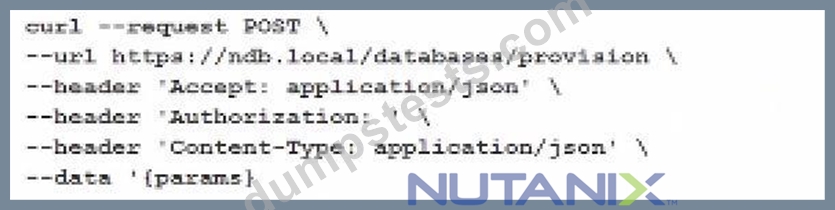
How can the administrator ensure that checks can be implemented in a single task?
- A. Run a playbook action
- B. Run a create action
- C. Run a eScript task
- D. Run a Pre-create task
Answer: C
Explanation:
To ensure that checks can be implemented in a single task while creating an application using NDB (Nutanix Database Service), the administrator should run an eScript task. eScript tasks allow for more complex scripting and logic to be executed, including performing checks, handling conditions, and interacting with APIs.
References:
* Nutanix Calm documentation on eScript Tasks.
* Nutanix Best Practices for Automating Database Management.
NEW QUESTION # 113
Refer to the exhibit.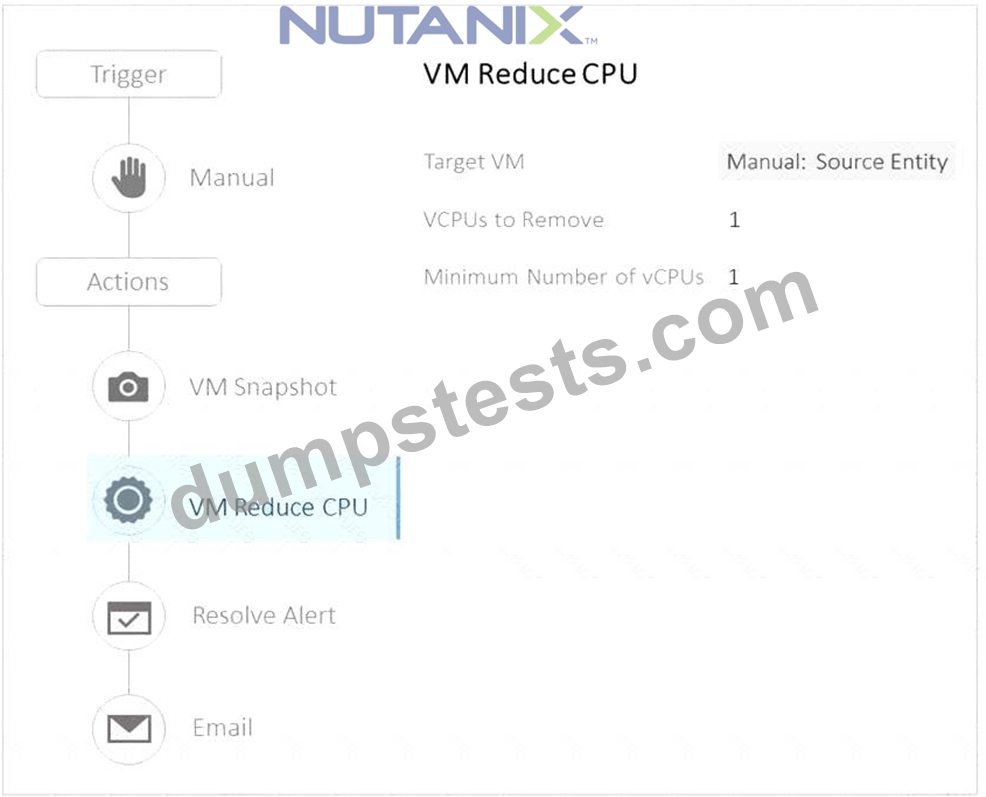
An administrator created the Playbook shown in the exhibit to allow for manual reduction of vCPU count on any selected VM within their environment. During a test run of the play on one of the VMs running in development, the administrator ran into an error that the Playbook cannot be completed against the selected VM.
Here are the details of the affected VM:
VM Name: VM2
vCPU: 4
RAM: 8 GB
OS: Windows 2016
Hypervisor: AHV
What caused this Playbook to fail?
- A. The VM needs to be powered off before vCPU can be reduced.
- B. Reduction of vCPU cannot be done on a VM with a running snapshot.
- C. This play cannot be executed against a VM on AHV.
- D. The play will cause the VM to go below the minimum vCPU.
Answer: B
Explanation:
The Playbook is designed to manually reduce the vCPU count on any selected VM within the environment.
However, it failed during a test run on VM2 because there was a running snapshot of the VM. According to Nutanix Multicloud Automation (NCP-MCA) principles, you cannot reduce the vCPU count on a VM that has an active snapshot1. This is because the snapshot captures the state of the VM configuration and data, and reverting to a snapshot will restore both the guest OS and the virtual hardware2. Therefore, changing the vCPU count while a snapshot is running will cause inconsistency and error. The other options are incorrect because:
* A. The Playbook can be executed against a VM on AHV, as long as there is no snapshot running3.
* B. The VM does not need to be powered off before vCPU can be reduced, as this can be done using hot-plug CPU feature4.
* D. The play will not cause the VM to go below the minimum vCPU, as the minimum number of vCPUs is set to 1 in the Playbook, and the VM has 4 vCPUs initially. References: Nutanix Support & Insights, Solved: Snapshot query !! - VMware Technology Network VMTN, Calm on ESXi Deployment
| Nutanix Community, Virtual CPU Configuration and Limitations - VMware Docs
NEW QUESTION # 114
A director would like to have an up to date Cluster Efficiency Summary report emailed on the first of every month to keep management up to date on how the cluster is being utilized.
How could a playbook be configured to satisfy this request with the least human interaction?
- A. Manual Trigger > Generate Report > Email
- B. Manual Trigger > Wait Until Day of Month > Generate Report > Email
- C. Report Trigger > Wait Until Day of Month > Email
- D. Time Trigger > Generate Report > Email
Answer: D
Explanation:
A time trigger is a type of playbook trigger that allows the user to specify a schedule for running a playbook.
This trigger is useful for automating tasks that need to be performed periodically or at a specific time. A manual trigger requires the user to initiate the playbook execution manually, which is not ideal for a recurring task. A report trigger is a type of playbook trigger that allows the user to run a playbook when a specific report is generated. However, this trigger does not guarantee that the report will be generated on the first of every month, as it depends on the report settings. A wait until day of month action is a type of playbook action that pauses the playbook execution until a specified day of the month. This action is unnecessary if the playbook already has a time trigger that specifies the desired schedule.
References:
* Nutanix Multicloud Automation Administration (NMCAA) course, Module 4: Playbooks, Lesson 4.1:
Playbook Triggers
* Nutanix Certified Professional - Multicloud Automation (NCP-MCA) 6.5 Exam Blueprint Guide, Section 3.1: Create a playbook to automate IT operations using X-Play
NEW QUESTION # 115
An administrator would like to be notified each time a subset of VMS within the Environment:Dev category is restored from snapshot.
Which trigger should the administrator use to satisfy this requirement?
- A. Event, where event type is Restored VM from Snapshot and Target VM is the specific VMS.
- B. Alerts Matching Criteria. where alert type is Snapshot Restoration, and the criteria is the VM names.
- C. Event, where the event is Snapshot Restoration, and the Target VM is VMS in Environment: Dev
- D. Alert. where alert type is Restored VM from Snapshot and target VM Category is Environment: Dev
Answer: C
Explanation:
An event trigger is a type of trigger that can be used to execute a playbook when a specific event occurs in the Nutanix platform. An event trigger can be configured with various parameters, such as the event type, the target VM, the target VM category, the target project, and the target user. In this scenario, the administrator wants to be notified when a subset of VMs within the Environment:Dev category is restored from snapshot. Therefore, the event trigger should have the following parameters:
Event type: Snapshot Restoration. This is the event that indicates a VM has been restored from a snapshot.
Target VM: VMS in Environment: Dev. This is the filter that specifies which VMs are relevant for the trigger. By selecting VMS in Environment: Dev, the trigger will only apply to the VMs that belong to the Environment:Dev category.
Other parameters: These can be left as default or customized as needed.
Reference:
Nutanix Multicloud Automation Administration (NMCAA) Course, Module 3: X-Play, Lesson 3.2: Creating and Managing Playbooks, Slide 13: Event Trigger Nutanix Certified Professional - Multicloud Automation (NCP-MCA) Exam Blueprint Guide, Section 3: Validate Blueprints, Playbooks, and Automation Settings, Objective 3.1: Determine the causes of a Playbook execution failure
NEW QUESTION # 116
A developer has a Development Blueprint that performs the following high level items:
Creates a Windows and Ubuntu Server.
Installs IIS on Windows
Installs MySQL on Ubuntu
As part of Development, there is a need for an Operator to restart IIS Services for troubleshooting purposes.
How should the developer add this functionality to the Blueprint?
- A. Create an Endpoint for the IIS server and a Runbook that restarts the service.
- B. Add an Execute Task in the Restart Action of the Windows/IIS Service.
- C. Add a Delay Task in the Restart Action of the Windows/IIS Service.
- D. Add an Execute Task in the Restart Action of the Application Profile.
Answer: D
NEW QUESTION # 117
An administrator has been tasked with creating a multicloud, three-tier application using Calm. The application needs to consist of:
A MongoDB backend database
A NodeJS Javascript runtime environment
An NGINX webserver
The administrator has access to an AWS account, as well as a locally hosted Nutanix cluster. The three parts of the application should be fully redundant, and be able to tolerate either a cloud provider outage, or a local Nutanix cluster outage.
What is the most appropriate solution the administrator should choose in order to meet the requirements?
- A. Create a Calm blueprint with MongoDB, NodelS, and NGINX VMs running on Nutanix, as well as MongoDB, NodeJS, and NGINX servers running in AWS on US-WEST-1 and US-EAST-1.
- B. Create a Calm blueprint with MongoDB, Node/S and NGINX VMs running on Nutanix, and a separate blueprint for MongoDB, NodeJS, and NGINX running in AWS on US-WEST-1 and US-EAST-1.
- C. Create a Calm blueprint with MongoDB, NodelS, and NGINX VMs running on Nutanix, then manually create three EC2 instances for MongoDB, NodeJS and NGINX in AWS running on US-WEST-1 and
- D. Create a Calm blueprint with MongoDB, Node/S, and NGINX VMs running on Nutanix, as well as an NGINX server running in AWS on US-WEST-1 and US-EAST-1.
Answer: C
Explanation:
US-EAST-1.
NEW QUESTION # 118
Refer to the exhibit.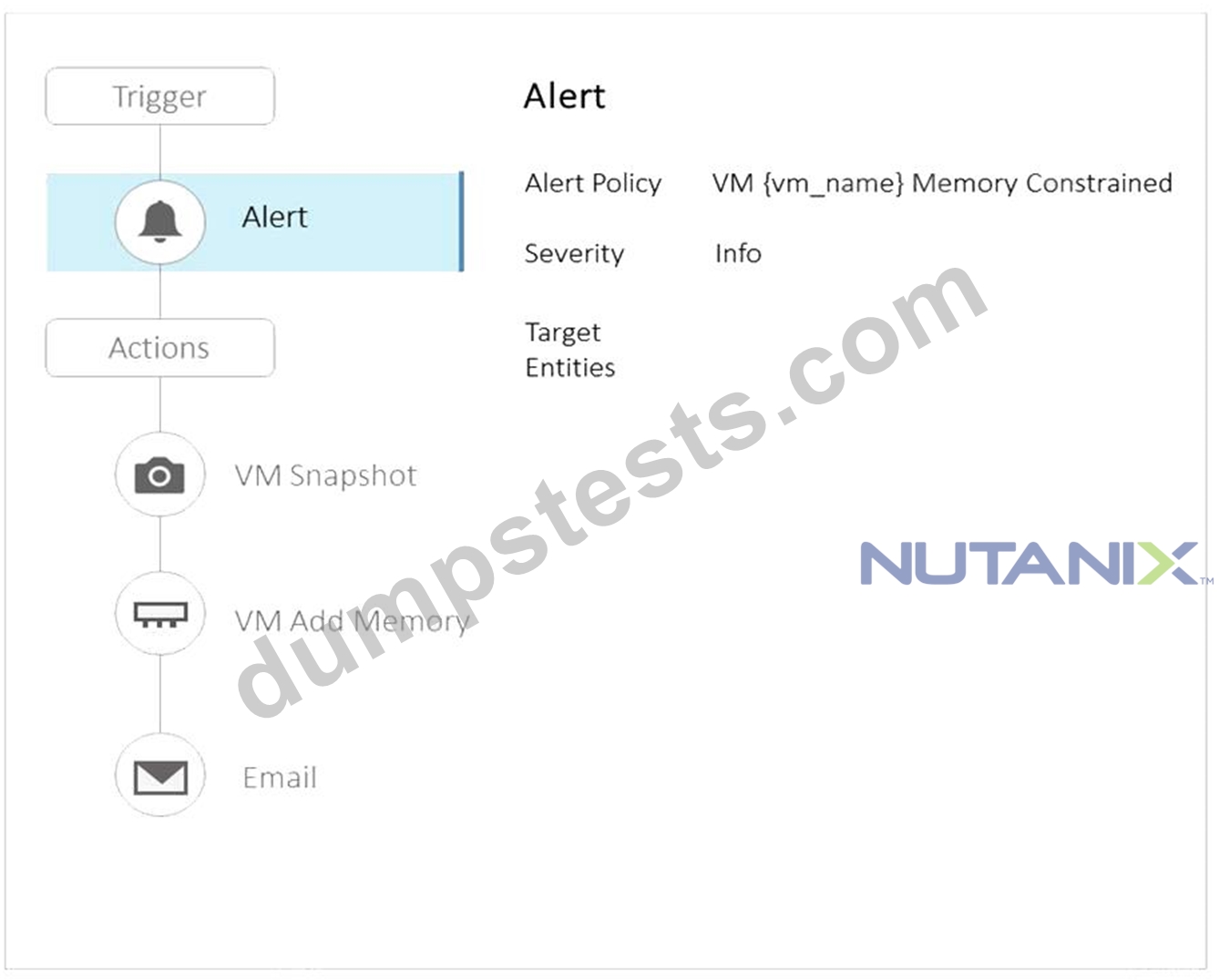
The VM appSAP01dev is a SAP development environment application and it is common to have memory constrained alerts on this VM, but the administrator wants to avoid adding memory to development VMs like this one, since this is normally done for only production VMs.
Which two actions should the administrator take to avoid adding memory to the development VMs? (Choose two.)
- A. Modify the Alert by adding the correct category
- B. Assign the category Environment:Development to development VMs
- C. Assign the category Environment:Production to the production VMs
- D. Disable the Alert in Prism Central
Answer: A,B
NEW QUESTION # 119
......
Verified Pass NCP-MCA Exam in First Attempt Guaranteed: https://pass4sure.dumpstests.com/NCP-MCA-latest-test-dumps.html