

71301T Dumps 2026 - New Avaya 71301T Exam Questions
Free 71301T braindumps download (71301T exam dumps Free Updated)
NEW QUESTION # 36
To which other component does the Avaya Aura Application Enablement Services (AES) Switch Connections connect?
- A. Avaya Aura Session Manager (SM) using SIP
- B. Avaya Aura Communications Manager (CM) using H.323
- C. Avaya Aura Communications Manager (CM) using SIP
- D. Avaya Aura Media Server (AAMS) using H.323
Answer: B
Explanation:
Adding a switch connection
The procedure include the following steps:
1. From the AE Services Management Console main menu, select Communication Manager Interface > Switch Connections.
2. On the Switch Connections page, in the Add Connection field, type a switch connection name (for example Switch1) For the Secure H323 Connection check box, do one of the following:
* For Communication Manager6.3.6 or later and TLS for the H.323 Signaling Channel (normally associated with FIPS Mode), select the Secure H323 Connection check box.
* For any previous release of Communication Manager without TLS for the H.323 Signaling Channel, uncheck the Secure H323 Connection check box.
Etc.
NEW QUESTION # 37
In Avaya Session Border Controller for Enterprise (SBCE) 7.x, you need to download the
46xxsettings.txt file to a Remote Worker device.
What needs to be configured under DMZ Services > Relay Services?
- A. Application Relay and File Transfer
- B. Reverse Proxy
- C. Application Relay and Reverse Proxy
- D. Application Relay
Answer: D
Explanation:
Relay Services are used to define how file transfers (e.g., for phone firmware upgrades and configuration), are routed to the Remote Worker endpoints.
Example: For accessing the file server using HTTPS protocol. The following screenshot shows the newly created Relay Services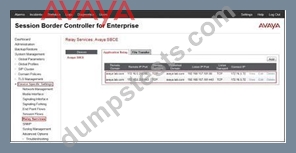
NEW QUESTION # 38
WebRTC is used for which type of calls?
- A. calls originated from external web browsers only
- B. calls originated from internal web browsers only
- C. video calls only
- D. calls originated from internal and external web browsers
Answer: D
Explanation:
The Avaya WebRTC Snap-in enables users inside or outside the Enterprise to make a secure call from their web browser to any endpoint to which Avaya Aura can deliver calls.
NEW QUESTION # 39
The Avaya WebRTC solution uses the web intensively to make media calls from a standard web browser in the internet, into internal and secure communication premises in the enterprise. Which statement about security between the Enterprise-edge and those standard Web browsers in the internet is true?
- A. A trust relationship based on certificates must be built to make WebRTC work.
- B. No trust relationship exists between enterprise edge security and web browsers; therefore, the security strategy is based on an Authorization Token instead.
- C. There must be a VPN connection between the Web Browser and the Enterprise-edge to build a WebRTC link.
- D. WebRTC only works within the Enterprise network. External Web Browsers must connect through an Avaya Session Border Controller for Enterprise (SBCE) via a SIP trunk.
Answer: B
Explanation:
Validation of the authorization token.
The WebRTC Snap-in will validate the authorization token created and encrypted by the web server. If the snap-in can decrypt the token and ensure that the time stamp is valid, it knows that the incoming HTTP request is valid. The time stamp will usually be short lived; on the order of 5-
10seconds to protect against reply attacks.
NEW QUESTION # 40
Which access control method is used by the Avaya Aura Application Enablement Services (AES) server for administrators?
- A. System Manager AES Management Menu
- B. Role-Based Access Control
- C. Challenge-Response shared-key method only
- D. Single Administrator simple password login
Answer: B
Explanation:
Role Based Access Control (RBAC)
Access to AE Services Management Console Web pages can be restricted by user authorization level. The operations that users are allowed to perform such as read, edit and delete can also be restricted.
NEW QUESTION # 41
To set Timers, URI Manipulation, and Header Manipulation that the Avaya Session Border Controller for Enterprise (SBCE) will use when signaling to the far-end server; a profile like
"avaya-ru" is provided by default. When configuring the Server Configuration, you must link to which type of Global profile?
- A. Topology Hiding
- B. Routing
- C. Server Interworking
- D. Signaling
Answer: C
Explanation:
The standard Avaya profile "avaya-ru" is cloned for the Call Server Interworking Profile. The Interworking function of the Global Profiles feature enables the SBCE to function in an enterprise VoIP network using different SIP protocols.
NEW QUESTION # 42
In which two locations is the Switch Password configured?
- A. In `ip-services' form on Avaya Aura Communication Manager (CM) and in `TSAPI link' on Avaya Aura Application Enablement Services (AES)
- B. In `cti-link' form on Avaya Aura Communication Manager (CM) and in `Switch Connection' on Avaya Aura Application Enablement Services (AES)
- C. In `cti-link' form on Avaya Aura Communication Manager (CM) and in `TSAPI link' on Avaya Aura Application Enablement Services (AES)
- D. In `ip-services' form on Avaya Aura Communication Manager (CM) and in `Switch Connection' on Avaya Aura Application Enablement Services (AES)
Answer: D
Explanation:
Enabling AE Services refers to administering the transport link between Communication Manager and AE Services.
Procedure
1. Type change ip-services. Communication Manager displays the IP SERVICES form
2. Complete Page 1 of the IP SERVICES form
3. Complete Page 3 of the IP SERVICES form as follows.
a. In the AE Services Server field, type the name of the AE Services server b. In the Password field, create a password.
This is the password that the AE Services administrator must set on the AE Server (Communication Manager Interface > Switch Connections > Edit Connection > Switch Password).
The passwords must exactly match on both Communication Manager and the AE Services server.
NEW QUESTION # 43
Which Avaya BreezeTM Cluster type is the Avaya Aura Presence Services snap-in installed on?
- A. Core Platform
- B. General Purpose
- C. Presence Services
- D. IM_Presence
Answer: A
Explanation:
Verifying that Presence Services snap-in is ready to support Presence and IM Procedure
1. On the System Manager web console, navigate to Elements > Avaya Breeze> Cluster Administration.
2. Locate the row for the cluster, and verify that:
* The Cluster Profile field shows Core Platform. etc.
NEW QUESTION # 44
When configuring a SIP Entity for Avaya Aura Messaging (AAM) in Avaya Aura System Manager, which Type of SIP entity needs to be selected?
- A. Messaging
- B. Avaya Aura Messaging
- C. Other
- D. Communication Manager Messaging
Answer: C
Explanation:
Define SIP Entity
Expand Elements, Routing and select SIP Entities from the left navigation menu. Click New (not shown). In the General section, enter the following values and use default values for remaining fields.
* Name: Enter an identifier for the SIP Entity
* FQDN or IP Address: Enter IP address of Avaya Aura Messaging.
* Type: Select "Other"
Etc.
NEW QUESTION # 45
You are creating the identity certificates that must be installed in the Avaya Session Border Controller for Enterprise (SBCE). Which statement about installing the certificate files in the SBCE is true?
- A. The SBCE must be rebooted before the files installation.
- B. The cert file and the Key filenames generated by the Certificate Authority must be different.
- C. The cert file and the Key filenames generated by the Certificate Authority must match.
- D. Both the PEM and Key files must be in a zip file.
Answer: C
NEW QUESTION # 46
When planning the Avaya Session Border Controller for Enterprise (SBCE) for SIP Trunking, what is a good practice to adopt?
- A. Use the same IP address on both, internal and external sides of the network.
- B. Use one Avaya Session Border Controller for Enterprise on the internal and external sides of the network.
- C. Name all internal and external interfaces exactly the same.
- D. Name Interfaces consistently, for example, A1 for Internal network to Call Server and B1 for external to Trunk Server.
Answer: D
Explanation:
Use the same interface mapping throughout! Examples in this section use:
NEW QUESTION # 47
The WebRTC snap-in needs to be loaded on which of Avaya BreezeTM cluster?
- A. Context Store EDP Cluster
- B. General Purpose EDP Cluster
- C. Work Assignment EDP Cluster
- D. Core Platform EDP Cluster
Answer: D
Explanation:
A cluster profile is a pre-loaded template that contains cluster attributes. The Core Platform cluster profile: A closed cluster that supports up to 10 Avaya Breeze servers.
NEW QUESTION # 48
Avaya Aura Presence Services 7.x is implemented on Avaya BreezeTM (formerly Engagement Development Platform (EDP)). When looking at Elements > Breeze > Service Management > Services, which status would you expect for a Presence Services snap-in that is ready to support Avaya Aura Presence Services?
- A. Accepting
- B. Loaded
- C. Installed
- D. Active
Answer: A
NEW QUESTION # 49
In the context of Avaya Aura Presence Services 7.x, what is a Fetcher?
- A. It is a watcher that is subscribing to current and future presentity information from another user.
- B. It is a user whose devices are sending status or presentity information on his behalf using a Publish message regarding his communication status.
- C. It is a kind of watcher that requests a one-time view of the user's current presentity information, but does not get future presentity information for a user.
- D. It is the presence information about a user that the system reports.
Answer: C
Explanation:
Fetchers pull the value of presence information for a specific presentity from the presence service. If a fetcher is fetching information on a regular basis, it is called a poller. Subscribers, on the other hand, subscribe to presentity information on the presence service.
NEW QUESTION # 50
Avaya Aura Presence Services 7.x is implemented on Avaya BreezeTM (formerly known as Engagement Development Platform (EDP)). When looking at Elements > Engagement Development Platform > Service Management, which status would you expect for a Presence Services snap-in that is ready to support Avaya Aura Presence Services?
- A. Accepting
- B. Loaded
- C. Installed
- D. Active
Answer: A
Explanation:
Enabling Avaya Breeze cluster running Presence Services
Before you begin
Ensure that the Avaya BreezeTM servers running the Presence Services are recovered / powered up.
Procedure
1. On the System Manager web console, navigate to Elements > Avaya Breeze > Cluster Administration.
2. Select the Presence Services cluster, and change the Cluster State to Accept New Service.
NEW QUESTION # 51
To log on the one-X Communicator to Avaya Aura Presence Services server, what do you enter in the IM and Presence / Server field of the one-X Communicator?
- A. the management IP-Address of FQDN of Avaya BreezeTM server
- B. the management IP-Address of FQDN of Avaya Aura Session Manager (SM)
- C. the SM100 IP-Address of FQDN of Avaya Aura Session Manager (SM)
- D. the SM100 IP-Address or FQDN of Avaya BreezeTM server
Answer: C
NEW QUESTION # 52
......
Verified 71301T dumps Q&As - Pass Guarantee Exam Dumps Test Engine: https://pass4sure.dumpstests.com/71301T-latest-test-dumps.html